
Bible number · 6 lenses
What Does 4 Mean in the Bible Read through 6 lenses
Again I lifted up my eyes, and saw, and behold, four chariots came out from between two mountains; and the mountains were mountains of bronze.
Again I lifted up my eyes, and saw, and behold, four chariots came out from between two mountains; and the mountains were mountains of bronze.
The number 4: the 4 stages of consciousness a person moves through, here set turning as one works
Esoteric lens · Ezekiel 1:16
and these were born to him in Jerusalem: Shimea, Shobab, Nathan, and Solomon, four, of Bathshua the daughter of Ammiel;
In the four hundred and eightieth year after the children of Israel had come out of the land of Egypt, in the fourth year of Solomon’s reign over Israel, in the month Ziv, which is the second month, he began to build Yahweh’s house.
The Philistines put themselves in array against Israel. When they joined battle, Israel was defeated by the Philistines, who killed about four thousand men of the army in the field.
Same number, 6 ways of seeing it. Tap one to jump to it.

The lot falls to Judah, and the border is walked out loud: up from the salt sea, past the valley of trouble, around the shoulder of the hills, down to the great sea. Then the counting begins. Town after town, by name, in groups, with the number at the end of each group. It reads like a tax list, and that dullness is the point. Land you have not named is land you do not really hold, and the same is true of a person. Whatever in you stays nameless does not sit quietly. It runs you from behind, and you call it bad luck or other people's fault. Naming is the first act of owning.
Then the last line, after all that careful arithmetic: the Jebusites who lived in Jerusalem could not be driven out, so they went on living there beside Judah, to this day. There is always one inhabitant you cannot evict. You do not become bright by picturing brightness; you become whole by knowing your own dark, and knowing it means living next door to it rather than winning. And the one place never cleared is the place where the temple will stand. The stone the builders threw away turns out to hold the corner.

Once the mind lays down its quarrel, vision opens in every direction. The voice of love speaks only after the strife is released, for a mind clenched in defense cannot see far. When the eyes are lifted, they look past the narrow ground that seemed worth fighting for and find that the whole was always given.
The reward for surrendering the small claim is sight itself. From the very place where the mind already stands, without the body moving an inch, the horizon widens on every side. The moment the grasping stopped, everything the mind could truly want came into view.
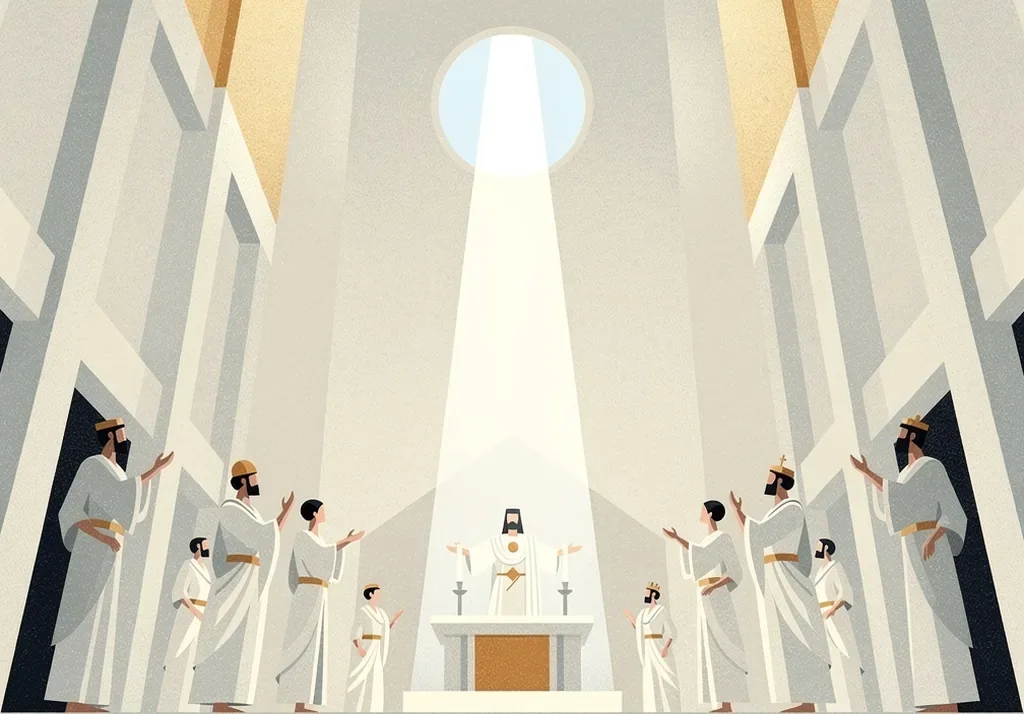
The 4 chariots are UFOs, the same craft that ride out as the 4 horsemen of Revelation, coming from between the mountains of brass to be fulfilled in the wars of the modern age. Brass is mentality and understanding, and these vessels issue from between 2 heights of it as the sky opens to the vision. The lifted eyes are mental perception waking, enlightenment turned upward to see what is really coming.
What happens in a person is the recognition of this prophecy, the same charge that fills Armageddon read as real craft and real conflict rather than comfort, the 4 chariots and 4 horsemen one.
Vipallāsa: Distortion Perception turns things over, and the foul gets taken as fair. Arms move in a manure pit precisely as they would move in clear water: the stroke is correct, the water is not water. Anyone will stay in filth for years once the eye has agreed to call it a lake.
Saṅkhāra: Formations Formations are both the making and the thing made. Skill, fortification, pottery, trade: the craft of his hands is assembled work, held up by continued effort, and the effort now goes entirely into staying afloat. The hands that shaped the works and the hands beating at the water are the same hands, busy to the last.
Anicca: Impermanence Nothing that is put up stays up. Pride and craft come down in one motion, the high opinion and the high wall together, and the tipping was always inside them rather than in the shove that finally arrived. Grim to watch in Moab, and good news for anyone who notices it in their own work before the water rises.
"Little faith" names the contracted ego state in which outcome attachment collapses the frame and drives the person to grasp at small guarantees from a world it has decided is withholding.[^5]
Grass claims no such insurance. It lives without scarcity consciousness, fully committed to its own existence for the single day it has, and that unclenched presence draws its covering without strain. The individual who wakes before dawn rehearsing worst-case scenarios has defaulted into a paradigm where provision must be earned by anxiety,[^4] treating abundance as something external and conditional rather than the natural state of a frame at rest in sovereignty.

Deeds are judged by the intentions behind them: the inside decides what an act is The Prophet said that deeds are weighed by what a person meant by them. Two people can do the identical thing, and one walks away clean while the other does not, because their reasons differed. So the cleanness of an act lives in the reason someone had for doing it.
Rayn: The rust that builds up over the heart Al-Ghazali compared the heart to a mirror, and the Quran speaks of a film that settles across it. Each act against a person's better sense leaves a mark, and the marks collect until the surface stops showing anything clearly. A clouded conscience keeps reporting back, and every report comes out already stained by the buildup.
Ḥijāb: The veil Al-Ghazali wrote about veils falling between a person and the light, and he placed the covering over the eye, never over the light. When someone finds something wrong everywhere they look, the wrongness has not spread across the world. Their own covering travels with them, so every room they walk into looks the same.
Sūʾ al-ẓann: Suspicion The Quran warns against carrying a heavy load of suspicion. Someone loaded with it finds a hidden motive behind every kindness, and the finding feels like sharp eyesight rather than a habit. They end up describing themselves while believing they are describing everyone around them.
Istiʿdād: The capacity a person brings Ibn Arabi taught that what comes down arrives the same for everyone, and each person receives it according to what they are ready to hold. Rain falling on good soil and rain falling on stone is the same rain. A settled heart can meet an ordinary day and an awkward remark and find nothing foul in either.
One line per lens.
We have seen that three signifies Divine perfection, with special reference to the Trinity: The Father, one in sovereignty; the Son, the second person, in incarnation and salvation, delivering from every enemy; the Holy Spirit, the third person, realising in us and to us Divine things. Now the number four is made up of three and one (3+1=4), and it denotes, therefore, and marks that which follows the revelation of God in the Trinity, namely, His creative works. He is known by the things that are seen. Hence the written revelation commences with the words, "In-the-beginning God CREATED."
In Lensightful, names, numbers and symbols light up in the text. Tap one to see what it means in each tradition you choose.
Get Lensightful on the App Store