
Bible symbol · 6 lenses
What Does God Mean in the Bible Read through 6 lenses
When Abram was ninety-nine years old, Yahweh appeared to Abram and said to him, “I am God Almighty. Walk before me and be blameless.
When Abram was ninety-nine years old, Yahweh appeared to Abram and said to him, “I am God Almighty. Walk before me and be blameless.
God: the Source within, the center at the crown that a person turns toward rather than the many powers scattered outward through the senses
Esoteric lens · Romans 8:28
But seek first God’s Kingdom, and his righteousness; and all these things will be given to you as well.
Jabez called on the God of Israel, saying, “Oh that you would bless me indeed, and enlarge my border! May your hand be with me, and may you keep me from evil, that I may not cause pain!” God granted him that which he requested.
Paul, called to be an apostle of Jesus Christ through the will of God, and our brother Sosthenes,
Same symbol, 6 ways of seeing it. Tap one to jump to it.

God's even-handedness reveals something startling: the image of God inside a person unites opposites and stands beyond good and evil, its light falling on the hidden, rejected parts as readily as on the polished mask.
A farmer stepping out at dawn finds rain on the neglected corner as fully as on the tended rows. The Father's sun, rising on evil and good alike, is the picture that heals the moral split inside us, shining into the whole soul without judgment. To become children of this Father is to grow whole: to welcome even the disowned and the unjust into full awareness, because the deep center that wants you whole holds back its light from no part of you.

The call to be perfect is not a demand to become something the mind is not. It is the invitation to live from what it already is. Love appears and asks only that a mind walk openly before it, hiding nothing, defending nothing, because there is nothing in it that needs to be hidden. Wholeness was never lost, only forgotten under the ego's long insistence that the mind is flawed and must repair itself first.
To walk before love and be perfect means simply to stop pretending you are damaged. The mind was created complete, and it is asked to remember that and live as what it truly is.
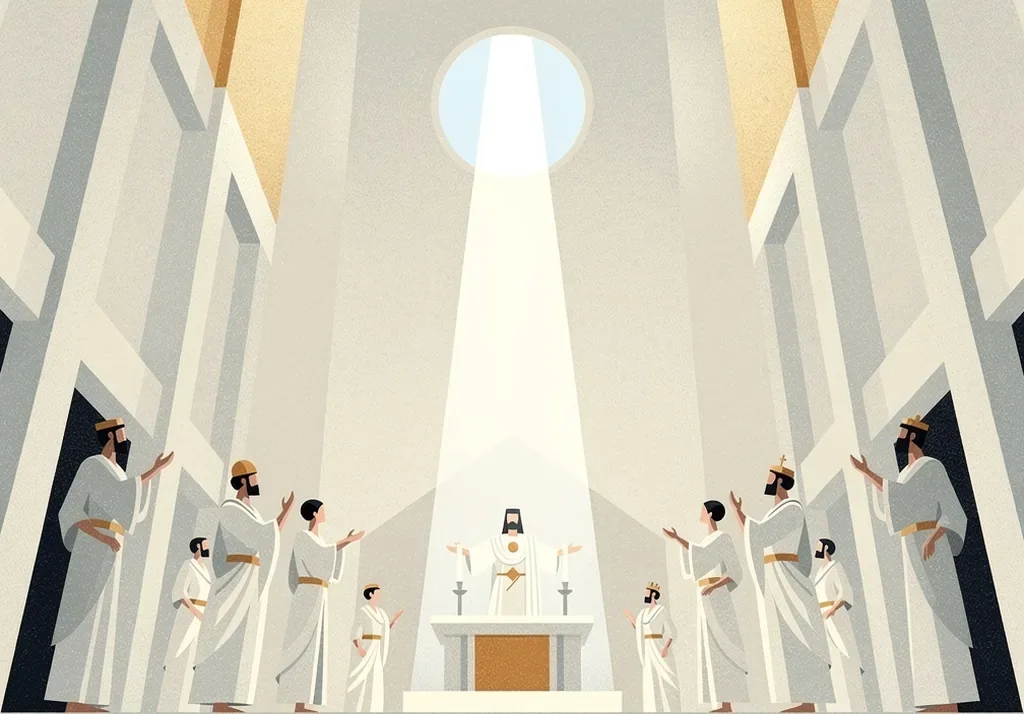
The kingdom stands first because it is within, not in any church and not beyond death, and it is reached by silent inward meditation rather than by fearing hell and its demons. Seeking within is the one work: sitting still and turning the attention inward until the inner centers stir.
That stillness wakes the chakras and the pineal gland in the head, and the rising light there defeats the destructive thoughts on their own ground, inside the person. What gets added is not treasure won from outside but every good state that flows once the inner realm is found, so nothing needful is chased anymore.

The clause "hate your enemy" names dosa directly. Dosa is one of the three root poisons, alongside greed and delusion, and it is the mental force of aversion: the impulse to injure or destroy what opposes us. Buddhism does not treat hatred as a natural right or a moral duty; it treats it as a fire that burns the one who feeds it, regardless of who the enemy is. The verse presents dosa not just as a temptation but as a received command, which is more dangerous still, because a community that encodes aversion into its moral law will reproduce it across generations without questioning it.
"Enemy" is not a category that exists in the world by itself; it is a category the mind creates by drawing a circle around "mine." Māna is the pride that measures self against other and sorts people into those who belong to us and those who stand against us. Without that conceit, there is no enemy. The neighbor earns love because māna places them inside the circle; the enemy earns hatred because māna places them outside it. The verse's whole logic holds only as long as that circle feels solid and fixed.
"Love your neighbor" uses a love that depends on belonging. Pema is warm, natural affection, but it is possessive: it follows kinship, membership, and shared interest. Buddhism distinguishes pema from mettā because pema carries a built-in boundary, and at that boundary the warmth turns cold. The verse makes this explicit: the same rule that commands love commands hate, because affection tied to category and aversion toward outsiders are two ends of the same rope.
Mettā is goodwill that does not track category. In classical mettā practice, the practitioner extends warmth outward in widening circles until it reaches hostile beings specifically, to dissolve the hierarchy the verse assumes. The standard image is a mother's wish that her child be safe from harm regardless of what the child has done. Mettā has no outer edge where warmth stops and contempt begins. The teaching Jesus gives in the verses that follow calls for exactly this structure.
· · ·
"Hate thine enemy" names aversion, the impulse to injure what opposes us (dosa). Hatred is a fire that burns the one who feeds it. Received as a command, it passes down through a community unquestioned.
The enemy is a category the mind makes. Pride measures self against other and sorts people into ours and theirs (māna). Without that circle, no enemy exists.
The love commanded is warm affection that follows kinship and shared interest (pema). At its boundary the warmth turns cold: "love thy neighbour, and hate thine enemy" are two ends of one rope.
Goodwill that does not track category has no outer edge (mettā). It widens until it reaches hostile beings, as a mother wishes her child safe whatever the child has done.
Under it lies the steady regard that extends care without grading beings as deserving or undeserving (upekkhā): sun on evil and good alike.

Benjamin "son of the right hand". The favored tribe, nearest the seat of power. The name replaced Ben-oni, "son of my sorrow," on the day he was born.
Hebrew "one who crosses over". The old word for someone from the far side of the river, an outsider who came across.
Pharisee "separated one". Separation made into a career. They kept apart on purpose so the law could be kept exactly.

Faqr: poverty before God The Quran calls people the poor ones and God the only rich one. Someone whose following is draining away toward another teacher feels robbed, as if a possession went missing. Nothing was owned in the first place, so nothing has been taken, and the ache loosens once that lands.
God is the only doer: every gift comes from one hand Al-Ghazali makes this short phrase the root of trusting God. When another person's fortune rises, the mind starts hunting for a cause: their charm, their luck, their maneuvering. Tracing the gift back to a single giver ends that hunt, because the one who rose was handed a share too.
Istiʿdād: readiness to receive Ibn Arabi writes that the giving never stops, and the difference sits in what each person can hold. Two people stand out in the same rain, and one is holding a cup while the other holds a bucket. Nobody has been shortchanged, and a smaller share says nothing about being valued less.
Ḥasad: envy Al-Ghazali describes envy as wanting a blessing pulled away from whoever has it. The pull runs strongest when that person stands nearby and does the same work you do. Underneath the resentment sits a complaint about how the shares were handed out, so the quarrel turns out to be with God rather than with the neighbor.
Riḍā: contentment with what is given Sufis put this above patience, since patience can still grind its teeth. A person can accept a smaller portion in public and go on arguing about it privately for years. Contentment ends that argument, and the portion already in hand stops registering as a loss.
One line per lens.
In Lensightful, names, numbers and symbols light up in the text. Tap one to see what it means in each tradition you choose.
Get Lensightful on the App Store