Open in the app
Bible symbol · 3 lenses

What Does Heaven Mean in the Bible Read through 3 lenses

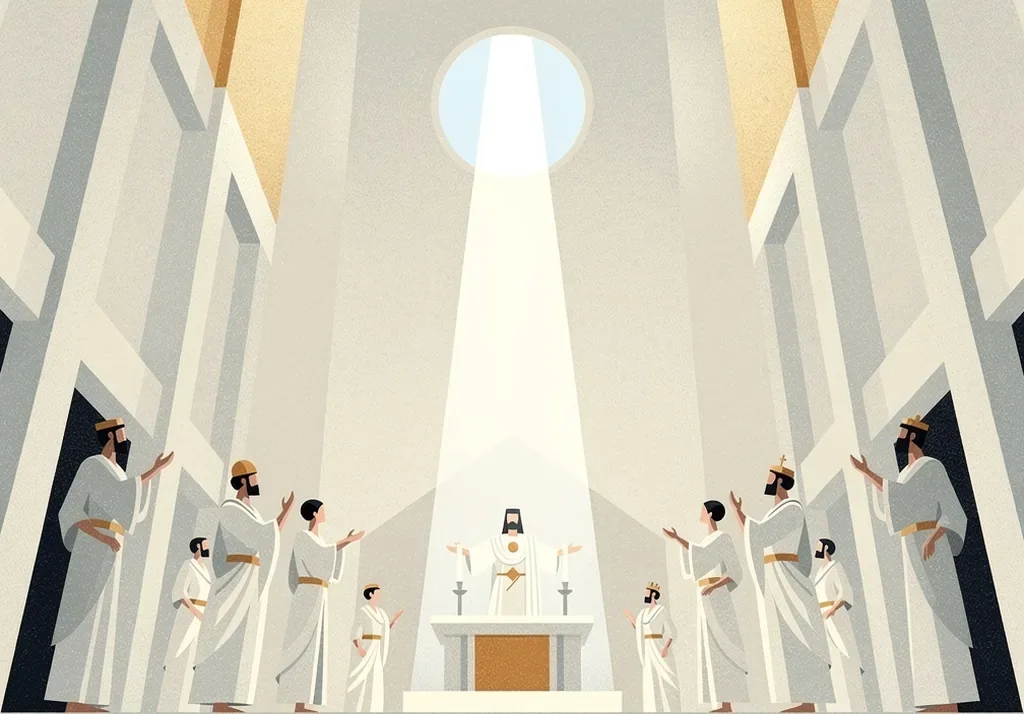
Jesus, when he was baptized, went up directly from the water: and behold, the heavens were opened to him. He saw the Spirit of God descending as a dove, and coming on him.
Matthew 3:16 · World English Bible

What does heaven mean in the Bible?

Heaven: the realm of love from which a sign is wrongly demanded, treated as a source of spectacle by a mind that will not receive it as truth.

Christian Psychology lens · Mark 8:11

Where heaven appears in the Bible

Genesis 1:1

In the beginning, God created the heavens and the earth.

Matthew 5:10

Blessed are those who have been persecuted for righteousness’ sake, for theirs is the Kingdom of Heaven.

1 Chronicles 16:26

For all the gods of the peoples are idols, but Yahweh made the heavens.

Heaven through 3 lenses

Same symbol, 3 ways of seeing it. Tap one to jump to it.

Christian Psychology · Matthew 3:16

Christian Psychology

When the mind has laid down its defenses, what seemed closed swings open, for the heavens were never shut except by the belief that love had to be barred out. Nothing new arrives. What was always present simply becomes visible to a mind no longer looking through fear.

The gentle descent shows how truth comes, not by force or storm but quietly, resting on a mind made still and willing. Peace does not have to be seized. It settles of itself the moment there is no longer any argument against it.

  • Heavens: the awareness of love that opens to a mind that has released its defenses
  • Dove: the quiet coming of the Spirit, truth that rests upon a mind made still and unafraid
Christian Psychology lensGo deeper in the app
Esoteric · Genesis 1:1

Esoteric

Heaven and earth are not 2 places but the 2 halves of a single person: the mind above and the body below, spirit and matter joined in one frame. Every awakening begins here, in the quiet moment consciousness first stirs and divides itself into an upper world of thought and a lower world of flesh, then sets out to reconcile them. The creation being described is your own coming into awareness, and it is happening now inside the one who reads it.

  • Heaven: the head and its realm of mind and spirit, the upper world of a person
  • Earth: the body and its ground of flesh, the lower world where thought takes form
Buddhism · Matthew 5:10

Buddhism

To suffer for righteousness is to suffer for the sake of morality (sīla): holding to what is right. The blessing is not in the suffering, but in refusing to abandon the good.

That refusal needs a resolve that does not waver under pressure (adhiṭṭhāna), and a patience that bears injury without breaking (khanti). The deepest test is whether you will hate in return. The righteous meet harm without ill-will (akkodha), they endure, but they do not become what they endure. And underneath all of it is a mind too settled to be moved (samādhi).

  • "Theirs is the kingdom of heaven": a peace no persecutors can reach (nibbāna).

· · ·

Khanti: Patient endurance / forbearance The central virtue here, and one of the perfections (pāramī). Khanti is the capacity to bear hardship, insult, and injury without retaliation or collapse. The Buddha called patient endurance the highest practice. The one persecuted for righteousness meets persecution with khanti: unbroken, unembittered, refusing to return harm for harm.

Adhiṭṭhāna: Resolve / unshakable determination Another perfection. Adhiṭṭhāna is the firm commitment to the path that does not waver under pressure. To stay true to righteousness while being attacked for it requires this rock-like resolve, the refusal to abandon what is right even when it costs everything.

Akkodha: Non-anger / freedom from hatred The persecuted one is tested precisely in whether they will hate back. Akkodha is the absence of anger even toward those who harm you. The Buddha taught responding to mistreatment without ill-will. This is what distinguishes righteous endurance from mere stubbornness: the heart stays free of hatred toward the persecutor.

Adhicitta / Samādhi: The steady, undisturbed mind The inner ground that persecution cannot touch. A mind established in stillness is not shaken by external loss or threat. The world can take everything outward, but the collected mind remains its own refuge. "Theirs is the kingdom" because the kingdom they hold is interior and untouchable.

Sīla: Virtue / integrity "For righteousness' sake" is the key phrase: this is suffering on account of sīla, of keeping integrity intact. The blessing is not in suffering itself but in suffering because one would not abandon what is right. The persecuted hold to virtue when releasing it would end the pain.

Nibbāna: The unconditioned peace The kingdom that no persecutor can reach. When the mind no longer depends on outward safety, comfort, or approval, there is a freedom nothing external can violate. "Theirs is the kingdom of heaven" is this inviolable peace, possessed now, in the midst of persecution, not granted only later.


What heaven means in each story

One line per lens.

  • PsychoanalysisManna (bread from heaven): the food of life, one with the holy bread and a healing medicine.Exodus 16:1-21
  • Clinical PsychologyManna (bread from heaven): spiritual food, the heavenly pattern that gives life meaning.Exodus 16:1-21
  • EsotericManna (food from heaven): possibly a psychedelic mushroom that opened sacred vision.Exodus 16:1-21
  • EsotericManna (bread from heaven each morning): wisdom from your higher mind that teaches you how to live.Exodus 16:1-21
  • PsychoanalysisThe heavens: The heavens represent everything above and beyond the individual: ideals, meaning, the sacred, the big patterns (archetypes) that shape all human lives.Genesis 1:1-2
  • ManifestationCreating the heavens and the earth: dreaming up a play, then entering it to live it.Genesis 1:1-2
Free · No account needed

Tap any symbol while you read

In Lensightful, names, numbers and symbols light up in the text. Tap one to see what it means in each tradition you choose.

Get Lensightful on the App Store