
Bible symbol · 4 lenses
What Does Jacob Mean in the Bible Read through 4 lenses
When Rachel had borne Joseph, Jacob said to Laban, “Send me away, that I may go to my own place, and to my country.
When Rachel had borne Joseph, Jacob said to Laban, “Send me away, that I may go to my own place, and to my country.
Jacob: the supplanting will that seizes and holds the birthright, the striving self that the inner love presses for fruit
Esoteric lens · Genesis 30:1
Jacob said, “Swear to me first.” He swore to him. He sold his birthright to Jacob.
He said, “Your name will no longer be called Jacob, but Israel; for you have fought with God and with men, and have prevailed.”
you offspring of Israel his servant, you children of Jacob, his chosen ones.
Same symbol, 4 ways of seeing it. Tap one to jump to it.

It is the end of twenty years in Haran, Joseph has just been born, and Jacob stands in front of his father-in-law and says it plainly: let me go, give me my wives and my children, you know exactly what my work has been worth. That is the first move, and it matters. A man who has served long enough in someone else's house has to ask for his own out loud, in words, because nobody hands you a life you were never able to name. Laban does not even deny it. He admits that everything good in his house came in on Jacob's back, and then tells him to set his own wage. Competence is never invisible. The people using you can usually see it more clearly than you can, and that is precisely why they keep you there.
Jacob does not whine and he does not rebel. He peels white stripes into fresh branches, stands them in the water where the strongest animals breed, and works the crooked arrangement he was handed until the strong stock comes out marked and his. There is nothing good about being harmless. He grows rich in flocks and servants and camels, and that, finally, is the only way anyone walks away from a man like Laban: not by complaining, but by becoming something he can no longer hold.

The bargain is sealed, and a mind gives away the everlasting thing it owned to satisfy a hunger that will pass by nightfall. What was eternal is signed over for what is momentary, and the exchange is made binding as though such a trade could ever be fair.
This is how a mind loses sight of what it is. It happens not through some great disaster but through a small, sworn consent to prize the immediate craving above the endless gift, treating its own wholeness as the cheaper thing.
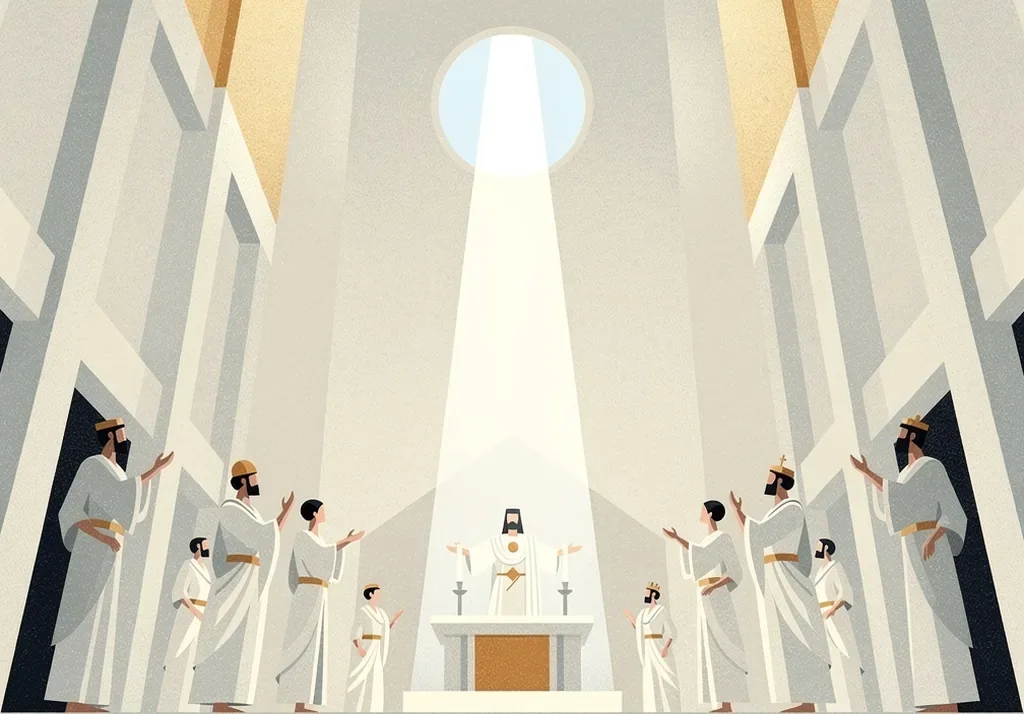
Jacob is the grasping lower self, named for the heel he clutched at birth, the part of a person that supplants and schemes to get ahead. Israel means the one in whom El, the divine, rules and prevails. To have the name changed after a night of wrestling is to have the higher nature win the long struggle against the lower, so that God governs the man rather than appetite. The prince who has power is consciousness itself, matured through conflict into command over its own house.
James "heel-holder". Jacob's name in Greek: the grip that comes in behind and takes the place ahead of it.
John "the LORD is gracious". Favor that arrives unearned, standing right beside the grip that grabs.
Zebedee "gift". Both brothers are sons of a name built on the root for bestowing, so the grasping and the grace come from the same source.
Simon "hearing". The faculty that takes something in before it acts.
Jesus "the LORD is salvation". The saving principle in a person, and it addresses hearing.
One line per lens.
that supplants, undermines; the heel
heel catcher; lier in wait ; supplanter; leaving behind; bringing to an end; recompensing; rewarding
JACOB rep. the Lord’s exterior man. 1950, 2088. J.,in the supreme sense, in general, rep. the Lord’s divine natural; but, whereas, when the Lord glorified his natural, it was other in the beginning, than in the progress, aud in the end: therefore, J. rep. various things, viz., in the beginning, the Lord’s natural as to truth; in the progress, the Lord’s natural as to the good of truth; and in the end, as to goo. 4538. J. rep. the Word, as to the literal sense. 3712.
In Lensightful, names, numbers and symbols light up in the text. Tap one to see what it means in each tradition you choose.
Get Lensightful on the App Store