
Bible symbol · 4 lenses
What Does Lord Mean in the Bible Read through 4 lenses
My soul, you have said to Yahweh, “You are my Lord. Apart from you I have no good thing.”
My soul, you have said to Yahweh, “You are my Lord. Apart from you I have no good thing.”
The Lord: read also as the right hemisphere of the brain, the silent side that pours into the reasoning side once a person quiets down.
Esoteric lens · 2 Peter 3:9
Joab said, “May Yahweh make his people a hundred times as many as they are. But, my lord the king, aren’t they all my lord’s servants? Why does my lord require this thing? Why will he be a cause of guilt to Israel?”
to the assembly of God which is at Corinth, those who are sanctified in Christ Jesus, called saints, with all who call on the name of our Lord Jesus Christ in every place, both theirs and ours:
Therefore his servants said to him, “Let a young virgin be sought for my lord the king. Let her stand before the king, and cherish him; and let her lie in your bosom, that my lord the king may keep warm.”
Same symbol, 4 ways of seeing it. Tap one to jump to it.

The beginning of wisdom is the moment the mind grows willing to hold something higher than the ego's counsel, to stand in awe before what it did not make. What is called fear here is really that reverence, the first turning away from the small self's authority toward a truth it can trust.
The knowledge of what is holy is not information but a direct remembering, the mind recognizing its own source. Understanding begins where the mind stops defending its separate will and lets that greater truth be true.
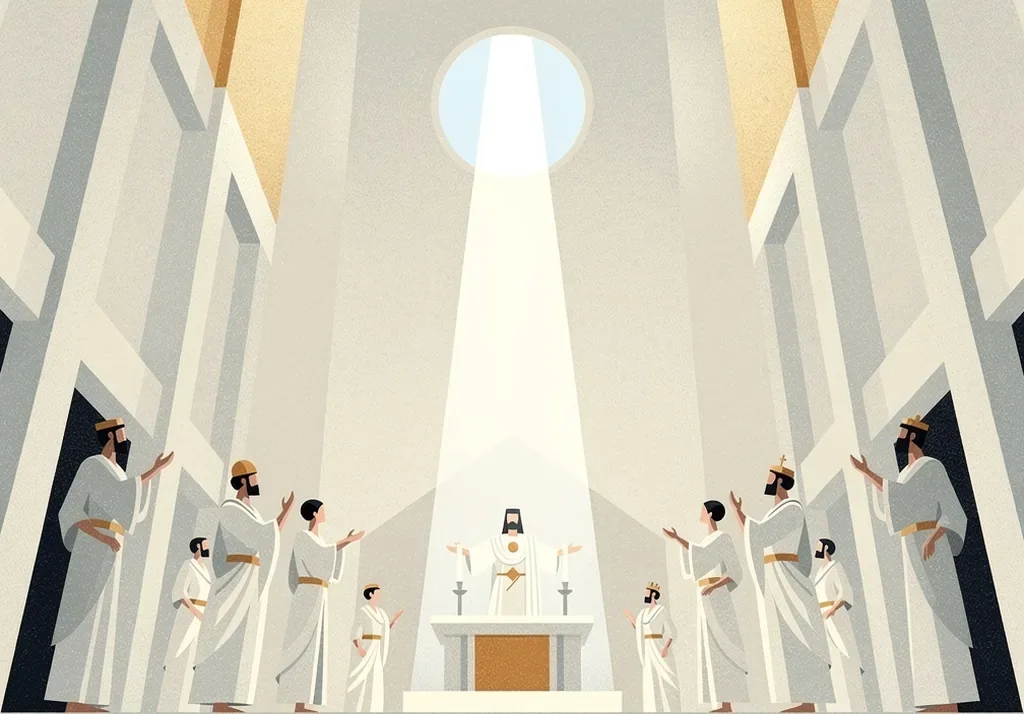
At the edge of the deep water, with the old bondage rushing up behind, the work of crossing is not done by struggle but by stillness. The higher power seated within moves on its own once the noise of the personal will goes quiet, and holding one's peace is the settling of the restless mind so that current can act.
The LORD is the ruling consciousness at the top of the body, and it carries a person through the divided waters while the lower self stops thrashing. What frees you is not effort but the inner stillness that lets the higher force take over.


Am I not your Lord: the yes came before memory The Quran tells of God gathering every soul before the world began and asking this, and every soul said yes. Naming him Lord now repeats an old answer rather than inventing a new one. That is why the words can land like recognition, as if the deepest part settled this long ago.
Muḥāsaba: Taking your own soul to account Al-Ghazali describes sitting down with your soul the way a business partner goes over the books. A person can mean something completely one day and drift from it within a week without noticing. Speaking to yourself about what you already promised is how the promise stays in force.
Tawḥīd al-afʿāl: Seeing one hand behind everything that happens Al-Ghazali puts this at the deep end of holding that God is one. Daily life credits good things to a job, a friend, luck, or hard work, and those all stay in the picture. They just stop being the origin, so every good thing traces back to one place.
Faqr: Poverty before God The Quran calls people the poor ones and God the rich. Saying you have no good apart from him admits that health, ability, and the next breath are on loan. Owning nothing outright turns out to be a relief, because nothing has to be defended as yours.
Shukr: Gratitude For al-Ghazali, gratitude starts with seeing who the gift came from. Enjoying a good thing is easy, and treating it as your due is easier still, since attention lands on the gift and stops there. Gratitude keeps the eye moving past the gift, so what you hold carries a reminder of who sent it.
One line per lens.
LORD, the, is essential good and essential truth. 2011. The L. is the Word, and the Word treats of him alone, and he is the God of heaven and carth, and from him alone the new church has its existence. A. R. 820. The L. was the God of the most ancient church, and called Jehovah; and also of the ancient church. 1343. and 327. The L. is called a little one, or a little child (isa. ix. 5), because he is essential innocence and essential love. 430.
In Lensightful, names, numbers and symbols light up in the text. Tap one to see what it means in each tradition you choose.
Get Lensightful on the App Store