
Bible symbol · 4 lenses
What Does Love Mean in the Bible Read through 4 lenses
He made its pillars of silver, its bottom of gold, its seat of purple, the middle of it being paved with love, from the daughters of Jerusalem.
He made its pillars of silver, its bottom of gold, its seat of purple, the middle of it being paved with love, from the daughters of Jerusalem.
Love in the Bible means putting another person's good ahead of your own. Jesus names love of God and love of neighbor as the two greatest commandments (Matthew 22:37-39), and 1 John 4:8 says that God is love.
But the fruit of the Spirit is love, joy, peace, patience, kindness, goodness, faith,
But as it is written, “Things which an eye didn’t see, and an ear didn’t hear, which didn’t enter into the heart of man, these God has prepared for those who love him.”
But God’s love has most certainly been perfected in whoever keeps his word. This is how we know that we are in him:
Same symbol, 4 ways of seeing it. Tap one to jump to it.

Actions speak louder than promises; repentant sinners enter the kingdom before pious pretenders.
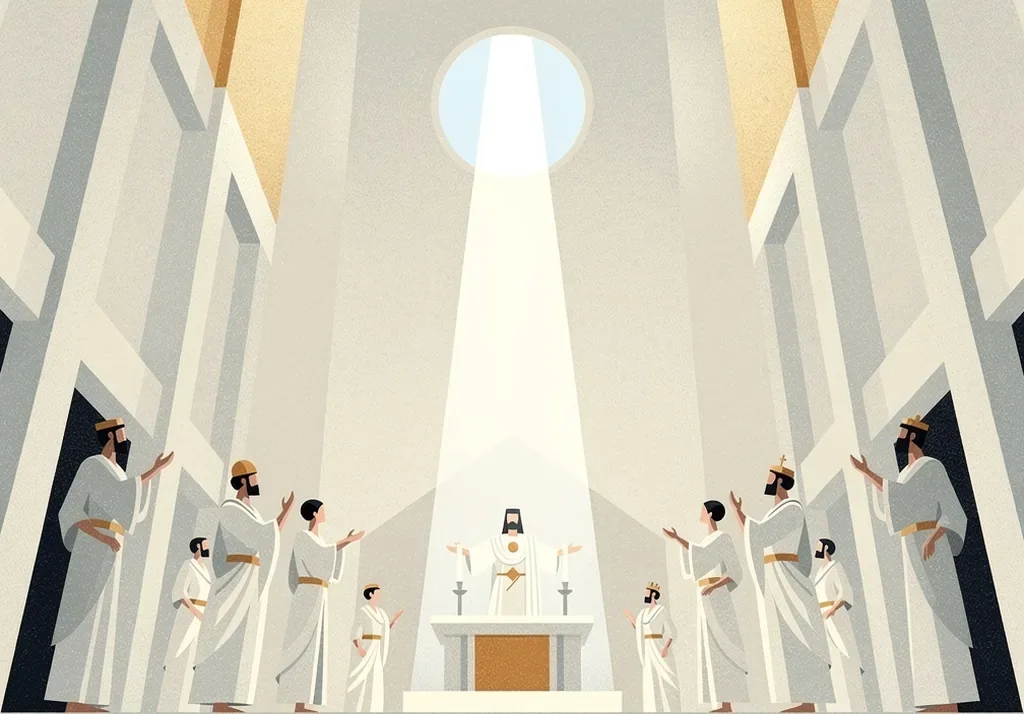
The chariot of the body is built from graded substances rising through a person: silver pillars for the moon's cool intuition holding the frame upright, a floor of gold for the sun's higher light beneath everything, and a purple canopy for the royal spirit crowning the whole. Its center is paved with love because the heart is the middle chamber where all these powers meet. This is the finished inner vehicle, matter refined into the seat where consciousness rides toward its own union.

Phala: Fruit, the result that ripens from a cause Phala is the outcome that grows out of what came before. Fruit swells on a tree that has been fed and watered, slowly, without anyone hanging it there by hand, and love, joy and peace come up the same way. For people being pressured to prove themselves by keeping a rule, this is the relief: tend the root and the branch takes care of itself.
Mettā: Loving-kindness Mettā is the wish that another person be well. Love comes first for a reason, since it is the soil the rest grow in, and among people who had been biting and devouring one another, plain goodwill toward the man across the table is the first thing to return. Kindness and goodness are mettā once it has hands, showing up in the tone of a voice and a willingness to be put out.
Pīti: Joy that rises in a settled mind Pīti is gladness arising on its own once the mind is at ease. Joy of this kind sits downstream of conduct: stop harming people, and the mind stops flinching, and gladness comes up like warmth after you step in out of the cold. Effort cannot manufacture it any more than a branch can be forced to blossom, which is why it ripens instead of getting built.
Passaddhi: Tranquility, the settling of body and mind Passaddhi is the quieting of a stirred-up body and mind. Peace follows gladness the way still water follows the last ripple, and it arrives in that order: goodwill, then gladness, then quiet. In a community arguing over who properly belongs, the settling is felt in the body first, the shoulders coming down before the argument is anywhere near resolved.
Khanti: Patient endurance Khanti is the strength to bear provocation without sending anything back. Patience is love under test: the other side keeps pressing, the faction keeps pushing, and nothing goes out in return. It works less like a gritted jaw than like a large room, which absorbs a shout that would fill a small one.
Saddhā: Confidence Saddhā is trust firm enough to keep a person moving. Faith ripens rather than gets declared: you act on it, something good follows, and the trust thickens, the way you come to rely on a bridge you have crossed a hundred times. It rests on the living source doing the growing, while the pull the Galatians felt ran toward something countable instead, a rule, a mark in the flesh.
· · ·
These are fruit, the result that ripens from a cause (phala). Fruit swells on a tree that has been fed and watered. No one hangs it there by hand. Tend the root and the branch takes care of itself.
The wish that another person be well (mettā) comes first: it is the soil the rest grow in. Among people biting and devouring one another, goodwill toward the man across the table returns first. Kindness and goodness are that wish once it has hands.
Gladness rises on its own once the mind is at ease (pīti). Stop harming people, the mind stops flinching, and gladness comes up.
The stirred-up body and mind quiet (passaddhi), still water after the last ripple.
Trust thickens as you act on it and good follows (saddhā). It ripens: "the fruit of the Spirit."

Kaẓm al-ghayẓ: Swallowing anger The Quran praises people who hold their rage in rather than let it out. The heat comes fast, before any decision, and the body wants to answer at exactly the volume it just received. Holding it for a few seconds does not end the anger, but it keeps the anger from choosing the words.
Ḥilm: Forbearance Al-Ghazali treats forbearance as the medicine for a hot temper. Someone carrying it still feels the sting, and their footing does not move, so they can keep listening while the other person is still loud. From outside the quiet can look like weakness, and staying quiet under pressure takes more of a person than firing back does.
Ḥifẓ al-lisān: Guarding the tongue Al-Ghazali gives a long warning about the damage a tongue does in a second. A sharp line takes no effort and cannot be pulled back, and the other person carries it long after the argument has ended. Guarding what leaves the mouth is mostly the work of catching one sentence before it goes.
God is gentle and loves gentleness: softness gets through where force cannot The Prophet taught that God gives for gentleness what harshness never gets. Someone braced for a fight already has their guard up, and a soft reply meets nothing they prepared for. Their anger finds nothing to push against, and it usually runs out on its own.
Ḥusn al-khuluq: Beauty of character The Prophet called the best people the best in character. Answering softly once is doable on a good day, and doing it while tired, embarrassed, or clearly in the right is another matter. Character gets built out of those small moments, until the gentle reply stops being a decision and becomes the way a person talks.
One line per lens.
In Lensightful, names, numbers and symbols light up in the text. Tap one to see what it means in each tradition you choose.
Get Lensightful on the App Store