
Bible symbol · 4 lenses
What Does Wind Mean in the Bible Read through 4 lenses
This also is a grievous evil, that in all points as he came, so shall he go. And what profit does he have who labors for the wind?
This also is a grievous evil, that in all points as he came, so shall he go. And what profit does he have who labors for the wind?
Wind: the empty yield of inner war, the nothing a mind is left holding when it inherits its own turmoil.
Christian Psychology lens · Proverbs 11:29
He said to them, “Why are you fearful, O you of little faith?” Then he got up, rebuked the wind and the sea, and there was a great calm.
He rode on a cherub, and flew. Yes, he soared on the wings of the wind.
In a little while, the sky grew black with clouds and wind, and there was a great rain. Ahab rode, and went to Jezreel.
Same symbol, 4 ways of seeing it. Tap one to jump to it.

In the provinces a man watches the poor get squeezed, and the word to him is: do not be shocked. Above that official stands a higher one, above him another, and over them all a king who takes his cut of every field. Shock is pushing against what already is, and pushing ties you to it. Look at what holds it up: each man needs the one below him afraid, and each one lives in the next harvest. Nobody in the stack is here, in this moment.
Whoever loves money never has enough, and as the pile grows so does the crowd eating out of it. The hunger is not about money. It is a self built out of things, which must keep adding or it feels like dying. The laborer who dug all day sleeps sweetly, thin supper or thick; the rich man lies awake beside full barns with the voice in his head counting, guarding not grain but his idea of who he is. Then one bad year empties it. He eats in the dark, sick and angry, the old pain in him feeding on the loss. Nothing is left for his son, and he leaves as he came, hands empty, having worked for wind.

The storm was never in the sea but in the mind that beheld it, and the fear waking the disciples was the mind's own turmoil dressed as a threat from outside. To still the winds and the waters is to correct at their source the thoughts that seemed to rage, for danger in the world is the outpicturing of an inner tempest.
The great calm comes not because the weather was mastered but because the mind remembered it was never truly in peril. Peace had been there the whole time, waiting behind the fear, needing only a teacher undeceived by the waves.
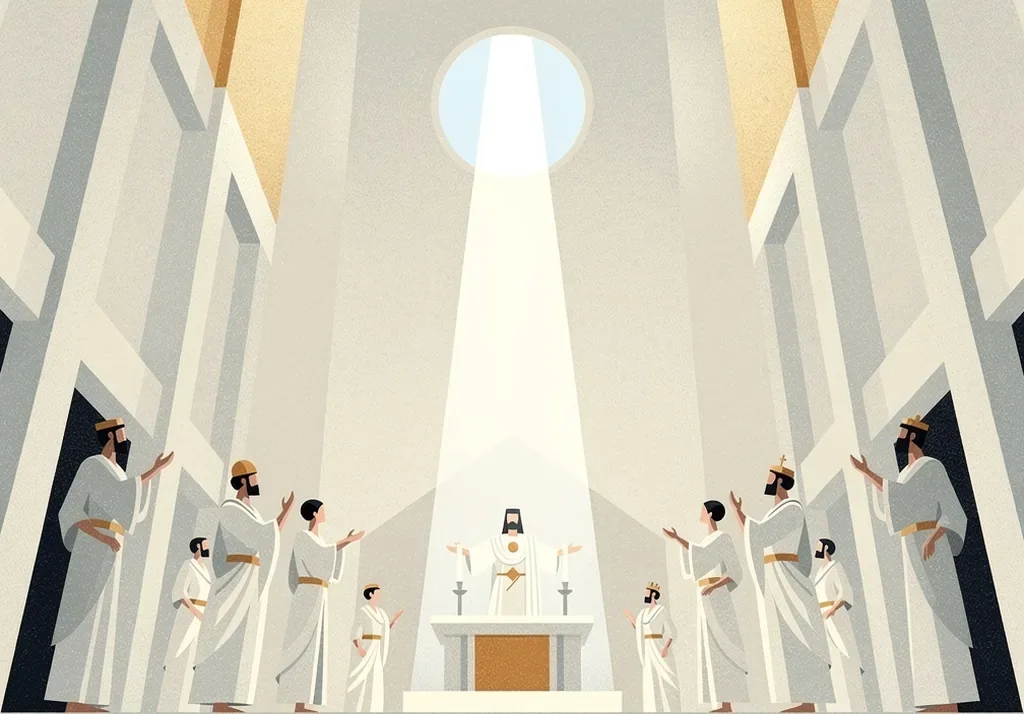
The cherub is the cerebrum, and higher awareness rides upon it, moving through the great vaulted brain as a rider moves upon a mount. To fly upon the wings of the wind is consciousness carried by the spirit, the moving air within that lifts awareness above its ordinary ground. The flight is not through outer sky but across the inner brain, the ruling faculty traveling the folds and currents of one's own head. What reads as a deity soaring over the world is the center of a person moving upon the cerebrum, borne on the breath of spirit inside them.

Uddhacca-kukkucca: Restlessness and Worry Worry twinned with agitation is one of the five hindrances. Long before any soldier knocks, the mind is already standing in that hall drafting an answer, scratching it out, beginning again, the way a tongue keeps returning to a sore tooth. Put the draft down; polishing it only wears the groove deeper.
Papañca: Mental Proliferation Papañca is thought breeding thought until the first moment is buried under commentary. "How" and "what" are the two doors in: how to phrase it, what to cite, what the ruler will fire back, what to say to that, like an argument rehearsed in the shower that never matches the one that happens. Every rehearsed scene is a conversation with people who are not in the room.
Sati-sampajañña: Mindfulness and Clear Comprehension Sati holds the present moment; sampajañña knows what the moment asks for. The answer belongs to the hour it is asked in, and a mind fully arrived in that hour will find words there, the way your hand comes up to catch a ball nobody warned you about. Rehearsal spends in advance the attention that would have been waiting when the door opened.
Vesārajja: Fearless Assurance Before an Assembly Vesārajja is the poise of someone who can be questioned from any angle without flinching. It rests on conduct rather than preparation: having already said in daylight what was whispered in the ear, there is nothing left in the pockets for a magistrate to turn out. Fear in a courtroom usually comes from something hidden, and where nothing is hidden, one speaks in front of rulers the same way one speaks over supper.
One line per lens.
In Lensightful, names, numbers and symbols light up in the text. Tap one to see what it means in each tradition you choose.
Get Lensightful on the App Store