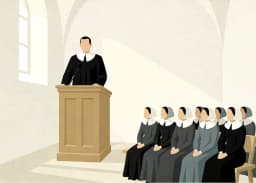
Mid-century illustration of a calm sea at dawn

2 Peter 3:10 · World English Bible

2 Peter 3:10 Meaning But the Day of the Lord Will

But the day of the Lord will come as a thief in the night; in which the heavens will pass away with a great noise, and the elements will be dissolved with fervent heat, and the earth and the works that are in it will be burned up.

What does 2 Peter 3:10 mean?

The timing is withheld, not the coming. Houses then were sun-dried mud brick, and a thief cut straight through a wall, so locks and watchmen bought nothing.

From the Protestant reading below.

2 Peter 3:10 through 2 lenses

The same verse, read by 2 traditions.

PROTESTANT

Protestant

The timing is withheld, not the coming. Houses then were sun-dried mud brick, and a thief cut straight through a wall, so locks and watchmen bought nothing. Delay reads as absence only to someone who assumed God owed them a schedule.

The day belongs to the Lord, and He alone sets its hour. The sky goes with a roar, the world's basic material dissolves in heat, and the ground burns with everything raised on it: crops, houses, records, fortunes. God does the burning, and He does it as judgment, the settling of accounts the prophets promised for centuries.

Protestant lensGo deeper in the app

SUFISM

Sufism

Dhikr al-mawt: Remembering death Al-Ghazali gave the closing part of his Revival to keeping death in mind. Someone who assumes more time is coming spends it loosely and pushes what matters to the far edge of the calendar. An ending with no announced date, held close, makes the hours weigh something while they are still in hand.

Everything perishes except His Face: only God lasts Sufis return again and again to this line from the Quran. Anyone can feel the wobble in things they counted on: work, standing, health, the arrangements that seemed settled. The line sorts what was on loan from what stands, and leaves a person one thing to lean on.

Tajdīd al-khalq: Creation renewed at every instant Ibn Arabi taught that the world is erased and remade at every instant, too fast for anyone to catch. Nothing a person holds is quite what it was a moment ago, so the ending being braced for has been running all along. That takes some of the dread out of it, since everyone has lived inside this pattern since birth.

Ikhlāṣ: Sincerity Ikhlāṣ means doing something for God alone, with nothing else mixed in. Much of what people build has a second motive tucked inside: being seen, being praised, being counted as important. When everything is put to the test, the borrowed motive goes first, and only the part meant for God holds up.

Fanā': Passing away of the self Sufis use fanā' for the self dropping out of the picture. A person dreading a great ending is usually dreading the end of themselves: the name, the story, the standing they have kept up. Those who have loosened that grip in advance find the fear has less to hold on to.

Baqā': Remaining in God Baqā' names what is left once the self has passed away, a life carried by God rather than by the person. Total loss frightens people because they picture nothing at all on the other side of it. Sufis describe the losing as half the story; the life that remains no longer depends on holding itself up.


Protestant lens

Live 2 Peter 3:10 today

  1. Open the folder, the drawer, or the account where you keep the record of what you have built, and look at it for a minute without adding to it. Then close it and go do something that will outlast it.
  2. Tell one person today something true that you have been saving for a better moment. The better moment is a thing you were assuming you would be given.
  3. When the day's pressure is really about protecting something, a position, a reputation, a number, do the honest thing rather than the defensive thing. Locks were never what kept it safe.

If none of what I have built were mine to keep, what would I do differently this afternoon?

The same truth in other traditions

Stoicism · Marcus Aurelius

Marcus reminded himself daily that everything he saw was already changing and would be gone, the city, the works, the names. Holding it loosely was not gloom, it was accuracy.

Buddhism

All made things come apart, and clinging to what cannot last is the engine of suffering. Nothing you have built is exempt, and knowing that changes how tightly you grip it.

Tao Te Ching

What is hard and rigid breaks, what is soft and yielding survives. Walls and locks are a kind of confidence that the way of things does not honour.

Mid-century illustration of Jesus teaching the crowd on a hillside above the sea

Free · No account needed

Read all of 2 Peter 3 through 17 lenses

Lensightful opens every verse of the Bible through the traditions you choose. Save readings, ask a follow-up question, and get one verse a day.

Get Lensightful on the App Store