
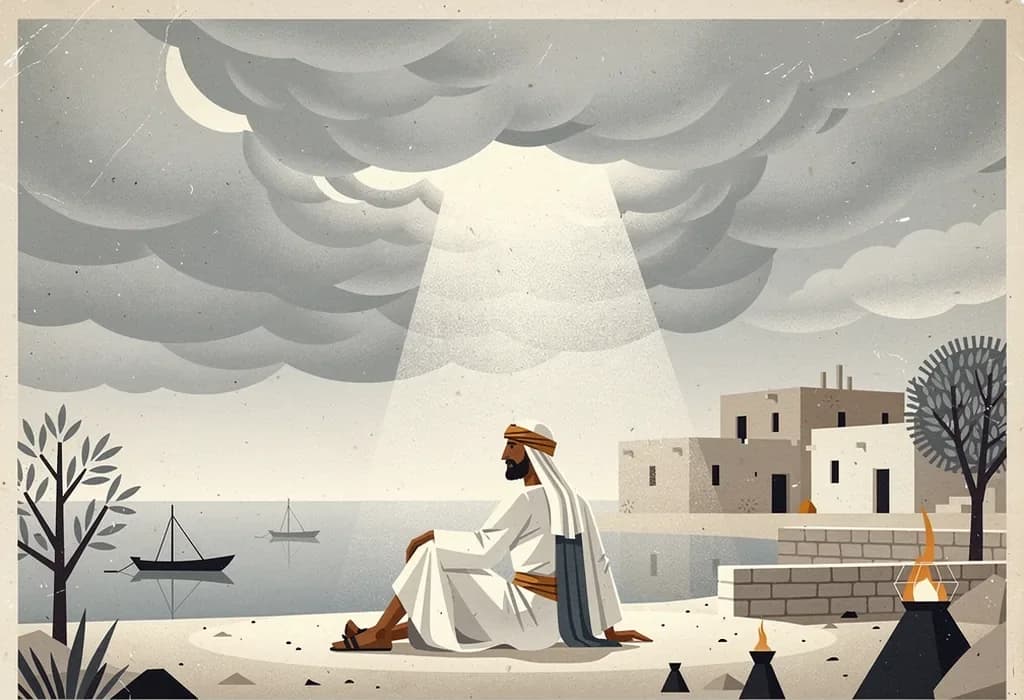
Job 14:10 · World English Bible
Job 14:10 Meaning But Man Dies
But man dies, and is laid low. Yes, man gives up the spirit, and where is he?
Job 14:10 · World English Bible
But man dies, and is laid low. Yes, man gives up the spirit, and where is he?
Maraṇa: Death Maraṇa is death, the close of a single life. The man who dies here dies the one death that finds all who are born, with king and beggar reaching the same gate at the end.
From the Buddhism reading below.
The same verse, read by one tradition.

BUDDHISM
Maraṇa: Death Maraṇa is death, the close of a single life. The man who dies here dies the one death that finds all who are born, with king and beggar reaching the same gate at the end. Think of a coat borrowed for a season that must one day be handed back: the body is on loan, and dying is the hour it returns, a debt come due for everyone who breathes.
Anicca: Impermanence Anicca is the passing nature of everything put together from parts. A person is a gathering of many pieces, and whatever is gathered will loosen and come undone, so the wasting away is that law made plain to the eye. Picture a sandcastle as the tide slides in: the shape was always going to soften and slump, and a body wears down in the same way, only slower.
Asubha: The body's decay Asubha is the plain unloveliness of the body once life has left it. Look closely at the wasting and the flesh only does what fruit does when it sits too long on the counter, softening, darkening, returning to its parts. Keeping that picture in view is not gloom for its own sake; it gentles the grip on a form that was always headed this way, so the parting reads as truth instead of ambush.
Viññāṇa: Consciousness Viññāṇa is awareness, the bare knowing inside each moment of experience. When a man gives up the ghost, this is what withdraws, along with warmth and vitality, and the old word ghost misleads, since nothing whole and self-shaped flies off anywhere. Warmth cools, knowing stops, and the body is left lying like a log dropped beside the road, with no one home inside it.
Anattā: Not-self Anattā means no fixed self can be found, either in life or once life ends. That is why "where is he?" meets silence: there was never a solid "he" seated inside to point at, only parts working together for a while. Asking where the man has gone is like blowing out a candle and asking which way the flame went; it goes nowhere, the conditions that held it have simply run out.
Buddhism lens
If there is no solid someone in there to protect, what would you stop spending your day on?
The old search goes part by part, not this, not this, turning over everything that could be the self and finding none of them holds. What is left is nothing you can point at.
When his wife died, Zhuangzi sat and spoke of the turning of the seasons: a shape was borrowed and has been given back. The grief was real and the form was never a possession.
What came together out of the elements loosens and returns to them. Nothing is lost in that, since nothing was owned in the first place.

Free · No account needed
Lensightful opens every verse of the Bible through the traditions you choose. Save readings, ask a follow-up question, and get one verse a day.
Get Lensightful on the App Store Buddhism