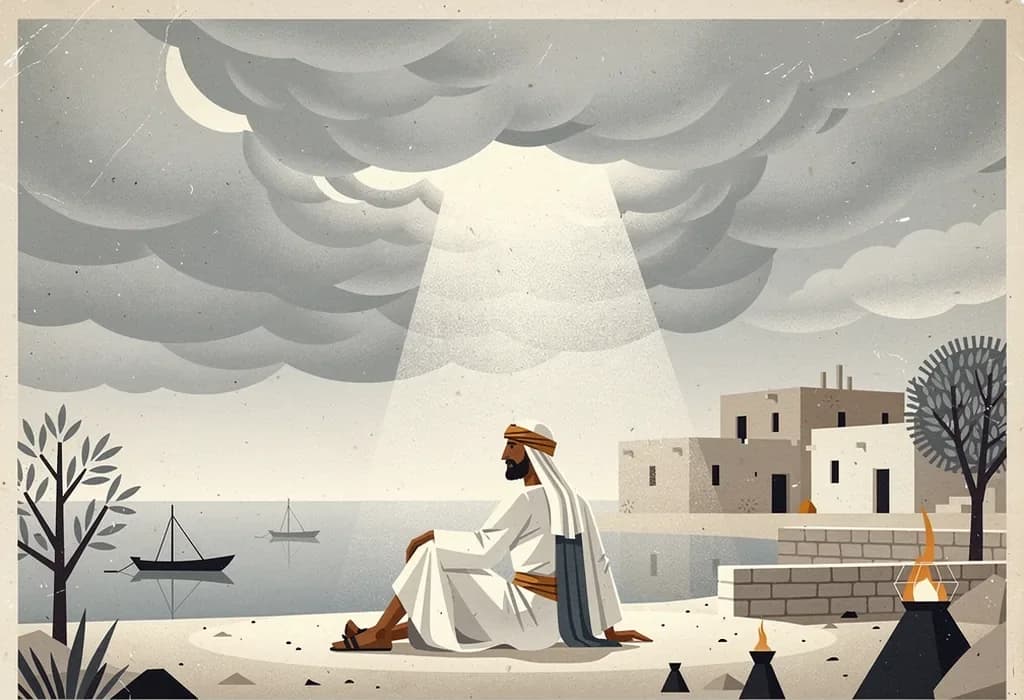
Mid-century illustration of Job sitting in the ashes under a storm, light breaking through the clouds

Job 2:10 · World English Bible

Job 2:10 Meaning But He Said to Her

But he said to her, “You speak as one of the foolish women would speak. What? Shall we receive good at the hand of God, and shall we not receive evil?” In all this Job didn’t sin with his lips.

What does Job 2:10 mean?

God alone is the doer: one hand behind both the gift and the loss Al-Ghazali comes back to this line again and again. When a life caves in, the mind races to assign blame: bad luck, enemies, some old mistake.

From the Sufism reading below.

Job 2:10 through 2 lenses

The same verse, read by 2 traditions.

SUFISM

Sufism

God alone is the doer: one hand behind both the gift and the loss Al-Ghazali comes back to this line again and again. When a life caves in, the mind races to assign blame: bad luck, enemies, some old mistake. Holding that a single hand stands behind the good years and the ruined ones stops that search cold, and a person is left dealing with God rather than with a pile of causes.

Shukr: Gratitude for what was given Al-Ghazali treats thankfulness and endurance as two halves of one thing. Someone stripped of everything can still remember that none of it was owed to them in the first place. Counting the good already received makes the loss feel less like a theft and more like something borrowed being handed back.

Riḍā: Contentment with what God sends The heart stops arguing with what has already happened. A person in ruin usually spends the whole day rerunning it, wishing one detail had gone another way. Contentment ends that rerun, and the strength that was going into protest returns to the business of living.

Ṣabr: Steady endurance under pain Patience of this kind never pretends the pain is small. Someone who has lost health, family, and standing feels every hour of it. Staying put under that weight without turning bitter or lashing out at the nearest person is the whole work, and it gets done hour by hour.

The most severely tested people are the prophets: hardship can track nearness A saying of the Prophet, repeated often by the Sufis. The quiet fear under heavy suffering is that it proves God has walked away. Reading it the other direction, the ones closest to God have often been hit hardest, so the pain stays as heavy as ever while it stops counting as evidence against a person's standing.

Ḥifẓ al-lisān: Guarding the tongue The Sufis watched their speech most carefully when under pressure. Grief loosens the mouth first: the bitter remark, the accusation flung upward, the words that cannot be pulled back. Keeping speech steady while everything else shakes stops the ruin from spreading into the one thing a person still holds.

SELF-HELP

Self-Help

A standard wide enough to receive what nobody wants is what keeps disaster from turning into an accusation.

Whoever expects only good from God is running a blueprint that a single night can break, and the break comes out of the mouth as a charge filed against heaven.

Taking good and evil as things received from the same hand leaves calamity its full weight while denying it a gap to open, and with no gap the pain arrives without torment stacked on top of it. What a man believes about where his losses come from is what holds his state steady, the steady state is what keeps his lips clean, and clean lips leave him a God he can still speak to in the morning, the only thing he owns that the disaster could not reach.

Self-Help lensGo deeper in the app

Sufism lens

Live Job 2:10 today

  1. When your mind starts replaying a hard thing today, wishing one detail had gone another way, let the rerun stop mid scene and go do the next small ordinary task.
  2. The next time someone close to you says something careless about your situation, answer gently instead of sharply. Keeping your words steady is the one thing still in your hands.
  3. Under real pressure today, a hard email, bad news, a tense drive home, give yourself one breath before you speak. What comes out in that first moment tends to be what you are actually standing on.

Which part of today's pain is the thing itself, and which part am I adding?

The same truth in other traditions

Stoicism · Epictetus

He taught accepting what happens as what happens, and spending your strength on how you meet it rather than on protesting that it came. The argument with the fact is the avoidable part.

Taoism · Zhuangzi

He met death and loss without staging a fight against them, letting the turning of things turn. What looks like coldness is really the end of resistance.

Buddhism · the two arrows

The first arrow is the pain itself, which nobody escapes. The second is everything we add to it, the protest and the rerun, and that one we can put down.

Mid-century illustration of Jesus teaching the crowd on a hillside above the sea

Free · No account needed

Read all of Job 2 through 17 lenses

Lensightful opens every verse of the Bible through the traditions you choose. Save readings, ask a follow-up question, and get one verse a day.

Get Lensightful on the App Store


