
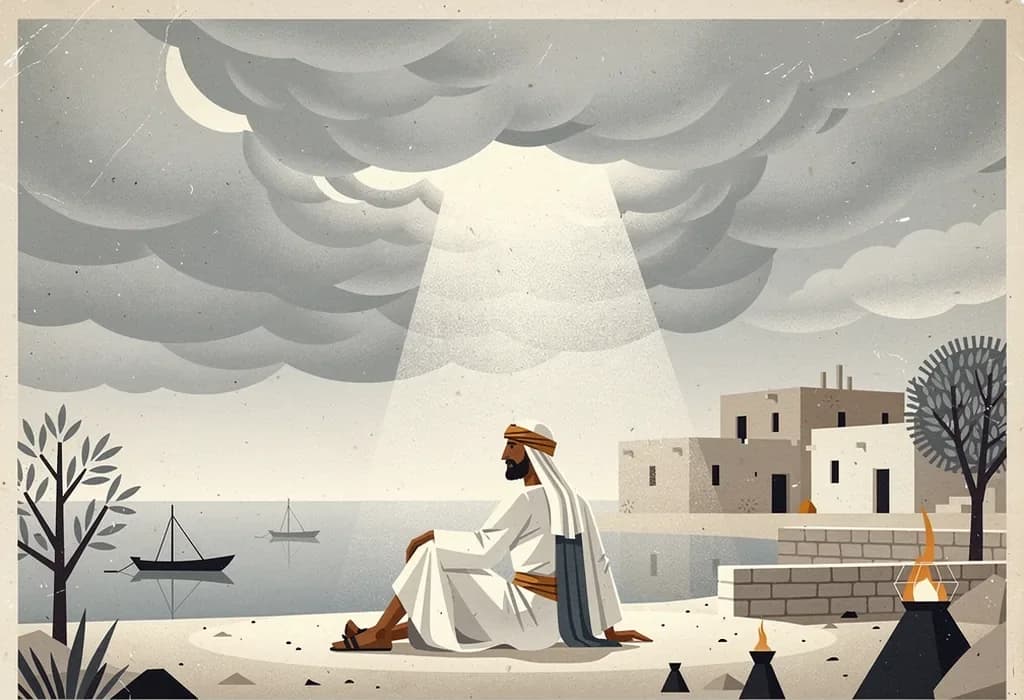
Job 7:20 · World English Bible
Job 7:20 Meaning If I Have Sinned
If I have sinned, what do I do to you, you watcher of men? Why have you set me as a mark for you, so that I am a burden to myself?
Job 7:20 · World English Bible
If I have sinned, what do I do to you, you watcher of men? Why have you set me as a mark for you, so that I am a burden to myself?
To be a burden to yourself is among the oldest forms of suffering. You carry a sense of wrongness, of being a mark against which life itself seems set.
From the Ego v. Being reading below.
The same verse, read by 3 traditions.

EGO & BEING
To be a burden to yourself is among the oldest forms of suffering. You carry a sense of wrongness, of being a mark against which life itself seems set. But this weight is made entirely of thought, of the mind judging and condemning the self it has imagined.
Nothing is setting you as a target. The ego does that, endlessly turning against itself. The burden is not your true nature but a story you keep telling. When you stop identifying with that self-judgment and rest in presence, the weight is no longer there, because it was never anything but thought.

BUDDHISM
Kamma: Action and its fruit Kamma is deed ripening in the one who does it. If I have sinned, what do I do to you: nothing at all, and that is the hard part, because the harm has nowhere else to go. A lie told in a locked room stains the teller and leaves the ceiling clean, so the reckoning Job demands from a watcher above him has been running quietly inside him the whole time.
Sati: Watchfulness Sati is attention resting on what is happening. The watcher of men feels to Job like an eye taking notes for a trial, following him into the sleepless night, counting his sores. Turned inward and stripped of the case it was building, that same close looking becomes a nurse checking a wound: full attention, no verdict.
Salla: The dart Salla is the dart of painful feeling. Set as a mark, Job has taken the first arrow already, in the boils, the buried children, the ruined nights. The second arrow is the one he is firing himself, the conviction that he has been aimed at, and it lodges deeper than the first, since a man who believes he is a target gets no rest between shots.
Bhāra: The burden Bhāra is the load, the five heaps a person carries and calls himself. A burden to myself weighs it exactly: body, feeling, memory, the whole bundle that once looked like a gift and is now a sack he cannot put down, because putting it down looks like dying. Nothing was added to the load when the sores came; the grip on it tightened.
Sakkāya-diṭṭhi: The view of a self Sakkāya-diṭṭhi is the view that a solid someone sits behind experience. Burden to myself splits Job in two, one who carries and one who is carried, and the sting of being a mark depends on that split, since an arrow needs a fixed thing to hit. Search for the carrier apart from the sores, the grief, the long hours before dawn, and no one is standing there to be aimed at.

AWARENESS
Becoming a burden to oneself is the precise weight of the ego: a man split in two, one part living and the other standing over it with a ledger. That accusing eye is taken for heaven's, and then every ache reads as punishment.
The watching itself is innocent. It has no interest in verdicts; it only sees, and in its light suffering stops being aimed at anyone. The complaint out of the ashes is already halfway home, because a man who can feel himself being watched has touched the awareness he has mistaken for a judge.
Ego v. Being lens
If the weight you carry is made of your own verdict, who is holding the gavel?
If you hold yourself dear, guard yourself well. You are your own refuge, and the mind that attacks itself does more damage than any opponent.
The thing itself does not disturb you, your judgment about it does. Remove the verdict and the weight goes with it.
The burden was the carrying. Set it down and you find there was never anything in your hands.

Free · No account needed
Lensightful opens every verse of the Bible through the traditions you choose. Save readings, ask a follow-up question, and get one verse a day.
Get Lensightful on the App Store Ego v. Being
 Buddhism
 Indian Guru