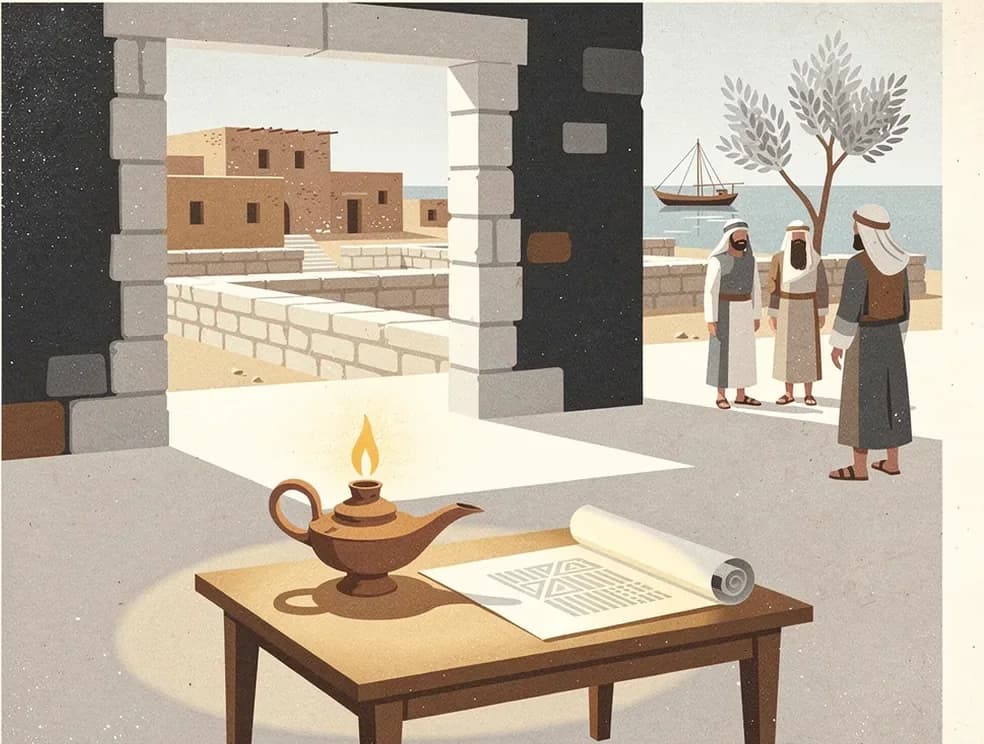
Mid-century illustration of an oil lamp and an open scroll on a table, disciples talking by the sea of Galilee

John 13:1 · World English Bible

John 13:1 Meaning Now Before the Feast of the Passover

Now before the feast of the Passover, Jesus, knowing that his time had come that he would depart from this world to the Father, having loved his own who were in the world, he loved them to the end.

What does John 13:1 mean?

Love that knows its own destination does not waver when the body's story turns toward loss. Certain of its return to the Father and untroubled by the appearance of leaving, a mind established in love goes on loving through every seeming ending, because what it is cannot be taken by anything that happens to a form.

From the Christian Psychology reading below.

John 13:1 through 2 lenses

The same verse, read by 2 traditions.

CHRISTIAN PSYCHOLOGY

Christian Psychology

Love that knows its own destination does not waver when the body's story turns toward loss. Certain of its return to the Father and untroubled by the appearance of leaving, a mind established in love goes on loving through every seeming ending, because what it is cannot be taken by anything that happens to a form. To love unto the end is not to love harder as the darkness comes; it is to love from a place the darkness never reaches.

So the nearness of departure changes nothing in a mind that has remembered its Source. The world offers its parting and its fear, and love simply continues, unhurried and unbroken. Those who are loved this way are held in something the world cannot interrupt, because the One who holds them was never truly in the world at all.

The world: the dream of separation the mind seems to inhabit, the passing scene love moves through without belonging to it. The Father: the Source love comes from and returns to, the changeless home that no departure can threaten.

Christian Psychology lensGo deeper in the app

EGO & BEING

Ego v. Being

Knowing his time had come, that his form would soon dissolve back into the source, he did not withdraw into fear. He loved to the very end. When you are no longer defending the small self against its own ending, the energy once spent on that defense is set free, and what flows out of you instead is presence, and presence toward others is felt as love.

This is what remains when nothing is left to protect. Facing his own departure, he turned not inward toward dread but outward toward those before him, loving them fully, because a being at peace with its own dissolving has nothing left to give but that peace.

Ego v. Being lensGo deeper in the app

Christian Psychology lens

Live John 13:1 today

  1. Think of something that is ending for you, a season, a role, a friendship. Let yourself care about it fully without needing it to stay.
  2. Be as present with someone today as you would be if it were the last evening you had with them. Put the phone in another room for the length of a meal.
  3. When the day falls apart and plans collapse, find the part of you that is still calm underneath the frustration. It is there, and it is not affected by the schedule.

What would you give your full attention to today if you knew it would not last?

The same truth in other traditions

Stoicism · Marcus Aurelius

Things outside you cannot touch what you actually are. Your own steadiness is the one place the world has no reach.

Tao Te Ching 16

Return to stillness as the root. Everything in the world rises and falls, and the one who rests at the root is not thrown by any of it.

Bhagavad Gita 2

What is real in you was never born and cannot end. Bodies come and go the way clothes do; the one wearing them does not.

Mid-century illustration of Jesus teaching the crowd on a hillside above the sea

Free · No account needed

Read all of John 13 through 17 lenses

Lensightful opens every verse of the Bible through the traditions you choose. Save readings, ask a follow-up question, and get one verse a day.

Get Lensightful on the App Store


