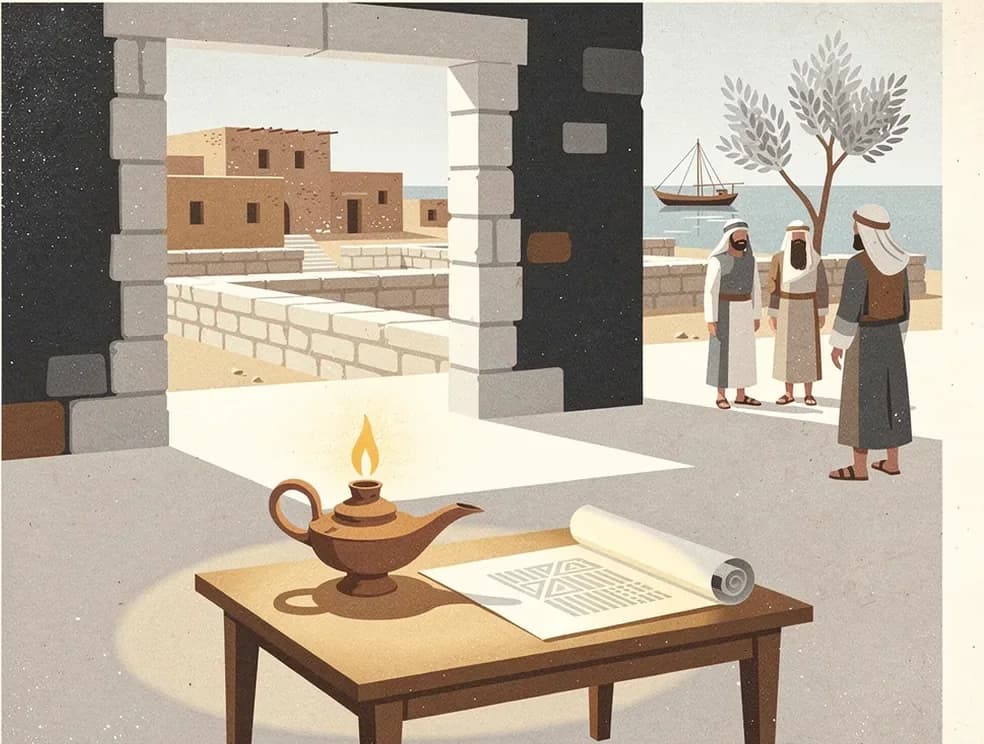
Mid-century illustration of an oil lamp and an open scroll on a table, disciples talking by the sea of Galilee

John 5:19 · World English Bible

John 5:19 Meaning Jesus Therefore Answered Them

Jesus therefore answered them, “Most certainly, I tell you, the Son can do nothing of himself, but what he sees the Father doing. For whatever things he does, these the Son also does likewise.

What does John 5:19 mean?

Can do nothing of himself names dependence, not weakness. Whatever the Father does, the Son does too, with nothing left off that list, and the watching never graduates into working alone.

From the Protestant reading below.

John 5:19 through 5 lenses

The same verse, read by 5 traditions.

PROTESTANT

Protestant

Can do nothing of himself names dependence, not weakness. Whatever the Father does, the Son does too, with nothing left off that list, and the watching never graduates into working alone.

Verily, verily renders a doubled amen, backwards for its hearers. Amen came after someone else's words, agreeing with them; set first, it puts the speaker's own authority behind what follows. What that authority stands behind is a claim about God: the Son's work is the Father's work. So the rescue he carries out is God's own move toward people, and whoever trusts the Son is trusting God himself.

Protestant lensGo deeper in the app

CHRISTIAN PSYCHOLOGY

Christian Psychology

The mind has no power that it invents on its own, and this is not a limitation but a release. Alone, cut off, imagining itself a separate self, it can do nothing real; every true act flows from the one Source and is only shared. The Son does what he sees the Father do, which means the awakened mind stops authoring its own private will and lets love act through it instead.

Here the whole burden of separate doing is lifted. A mind that no longer strains to create apart from its Source discovers that everything worth doing was never its to do alone. It only had to look, and follow.

Father: the one Source from which all real action flows, the love the mind was made to reflect rather than replace. Son: the mind at its truest, powerful not by inventing its own will but by mirroring what it sees the Source do.

Christian Psychology lensGo deeper in the app

ESOTERIC

Esoteric

The Son is the awakened awareness in a person and the Father is the source spirit above it, and the lower moves only as it watches and mirrors the higher. The manifest self, working in flesh, has no motion of its own apart from the pattern flowing down from the origin within; it copies what it sees the source do. This is the inner law by which the finer force directs and the visible life follows.

The self in the body acts as a reflection acts, holding no independent power. Whatever the source above sets in motion, the awareness below carries out in the same way.

Son: the awakened awareness manifest in the body, moving only as it mirrors the higher Father: the source spirit above, the origin from which all inner motion flows down

SUFISM

Sufism

ʿUbūdiyya: Servanthood Ibn Arabi calls servanthood the highest place a person can stand. Under pressure to justify yourself, the quick move is to claim the work as your own, and a servant has no such claim. The pressure finds nothing to grip, and they can answer calmly, since losing the credit costs them nothing.

Mushāhada: Witnessing Sufis use the word for seeing God firsthand rather than on someone else's word. A person living this way watches before moving, so their timing comes from what stands in front of them instead of their own hurry. They do the next thing because they saw it, the way you hand someone a tool when you see they need it.

The heart is a mirror: a clean one shows whatever stands before it Al-Ghazali returns to this image constantly, and his point is that a mirror adds nothing of its own. Dust and rust are the only reasons it gives back a false picture, so the work goes into grudges, showing off, the need to win. A cleaned heart gives back what stands in front of it, without twisting it.

You did not throw when you threw, but God threw: the deed is yours, the power is not The Quran says this to the Prophet after he threw a handful of dust in a battle. Both halves stand: his arm moved, and the force that made it land came from elsewhere. Someone challenged about what they have done can say the same thing honestly, without boasting and without denying they acted.

I become the hearing he hears with and the sight he sees with: closeness makes God the one at work God speaks these words in a saying of the Prophet, about the servant who keeps drawing near through small, steady devotion. Such a person still moves their own hands and speaks in their own voice. The patience in them comes from past their own supply, which is why it holds when they are being accused.

Takhalluq bi-akhlāq Allāh: Carrying God's qualities at human size Al-Ghazali uses this for the qualities a servant picks up by keeping close company with God. Mercy shows up as patience with someone slow; generosity shows up in what a person gives away without a fuss. Anyone who keeps watching what God does begins to move the same way, and the family resemblance shows in their actions, not their claims.

SELF-HELP

Self-Help

Copying exactly what you have watched work is not a beginner's crutch, it is how the highest capability operates.

Doing nothing out of one's own invention sounds like limitation and functions as leverage. What the Son sees the Father doing supplies a working template, the template ends deliberation, the end of deliberation produces certainty, and certainty moves as action that lands the way the original landed, with none of the energy most people burn deciding what to try.

Most people accept modelling while they are beginners and abandon it the moment results bring them attention, improvising at the exact point where the copied strategy was producing everything. Giving up authorship of the method costs a person the credit and nothing else, and buys the outcome years before trial and error would have delivered it.

Self-Help lensGo deeper in the app

Protestant lens

Live John 5:19 today

  1. Before you start work today, ask what is already underway that you could join, instead of inventing something that makes you look necessary.
  2. Watch one person who is good at something you are not, closely and without competing, and copy a single thing they do.
  3. When a decision lands on you under pressure, pause long enough to ask what the wisest person you know would do here, then do that instead of your first instinct.

Where am I straining to act on my own when I could be following?

The same truth in other traditions

Tao Te Ching 48

The sage acts by not forcing, and the work still gets done. Moving with what is already moving is strength, not passivity.

Bhagavad Gita 11:33

The best action is done as an instrument, in step with something larger, rather than invented out of your own will. Being used is not being diminished.

Sufism · Rumi

I am the pen in the hand of the writer, and the pen does not decide the sentence. What flows through it is fully the writer's and still fully written.

Mid-century illustration of Jesus teaching the crowd on a hillside above the sea

Free · No account needed

Read all of John 5 through 17 lenses

Lensightful opens every verse of the Bible through the traditions you choose. Save readings, ask a follow-up question, and get one verse a day.

Get Lensightful on the App Store