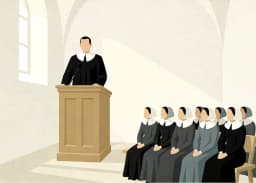
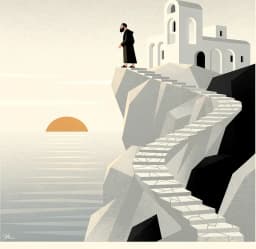
Mid-century illustration of a calm sea at dawn

Mark 8:34 · World English Bible

Mark 8:34 Meaning He Called the Multitude to Himself

He called the multitude to himself with his disciples, and said to them, “Whoever wants to come after me, let him deny himself, and take up his cross, and follow me.

What does Mark 8:34 mean?

Carrying a cross was no figure of speech: a condemned man hauled the crossbeam to his execution, a walk announcing he was finished. Taking one up means a person's claim on their life is finished too.

From the Protestant reading below.

Mark 8:34 through 8 lenses

The same verse, read by 8 traditions.

PROTESTANT

Protestant

Carrying a cross was no figure of speech: a condemned man hauled the crossbeam to his execution, a walk announcing he was finished. Taking one up means a person's claim on their life is finished too.

Behind deny sits the word for disowning another person, turned inward, so someone's preferences stop being the deciding vote. That clearing has one destination, following behind Christ. None of this purchases a place with him; the cross that rescues is the one he carried. The terms went to the whole crowd, and they begin with wanting to come.

Protestant lensGo deeper in the app

ORTHODOX

Orthodox

Denying yourself means refusing the small tyrant inside that wants every situation bent toward its own comfort. The person God made stays; what goes is the standing demand to be served, admired, and obeyed. Training the will this way is medicine, not punishment.

A cross is picked up, and hardship that simply arrives becomes one only when it is accepted on purpose, out of love. Following comes last for a reason: the road runs through the cross into resurrection, so the carrying aims at life, walking behind someone who has already gone the whole distance.

CHRISTIAN PSYCHOLOGY

Christian Psychology

The self that must be denied is not the true one but the little self the ego made, the identity built on separation and defended by guilt. To lay it down is not loss but release, the setting aside of a burden the mind mistook for who it was. What follows love cannot be the fearful self, so that self is quietly let go in order to go on.

The cross that is taken up is the willingness to let this happen, to bear the undoing of the ego without turning back. It is not a call to suffer but a call to release, and what looks like a heavy thing to carry is only the weight of everything the mind is finally willing to set down.

Cross: the willingness to let the ego be undone, the burden of release carried without turning back, which weighs only as much as what the mind lays down upon it

Christian Psychology lensGo deeper in the app

EGO & BEING

Ego v. Being

To deny yourself is not to punish the body or renounce the world. It is to see that the self you defend, the one made of memories and grievances and the endless story of me, is not who you truly are. When you stop identifying with that voice in the head, something deeper remains, awake and at peace.

Taking up your cross means accepting whatever this moment contains, even suffering, without resistance, so that the burden becomes an opening rather than a wall. You follow not by copying a person but by living fully in the present, awake in awareness instead of lost in thought.

Ego v. Being lensGo deeper in the app

CLINICAL PSYCHOLOGY

Clinical Psychology

To carry a cross is to accept the specific burden that belongs to a person and to accept it voluntarily, without pretending it should have fallen to someone else. Self-denial does not erase the self. It disciplines the self, refusing to let immediate wants govern the whole of a life.

Every person is handed a load of suffering and limitation. You can drag it in bitterness or shoulder it with purpose, and only one of those turns the weight into meaning. Pick up what is yours and walk forward under it.

Clinical Psychology lensGo deeper in the app

BUDDHISM

Buddhism

Anattā: Not-self

The seeing that no fixed, separate self stands behind experience. Deny himself invites you to look for the solid "me" and find it missing, the way a fist opens and there was never a thing inside, only fingers. The self you set down is a weight that was never yours to carry.

Nekkhamma: Renunciation

The glad letting-go of what binds. To come after him a person leaves the old grip behind, loosening the hold on comfort and name the way a traveler drops a heavy pack at the trailhead. Renunciation feels like loss only until the shoulders lift.

Khanti: Patient endurance

The strength that bears a hard thing without flinching. Take up his cross means shouldering the weight the road lays on you and walking on, carrying it steadily rather than trying to shrug it off. A load borne with a settled mind grows lighter with each mile.

Sīla: Ethical resolve

The firm commitment to a chosen path. Follow me asks for the whole direction of a life, one steady course held day after day rather than a mood that fades by evening. A boat keeps its heading only by a hand that stays on the tiller.

Cāga: Relinquishment

The open-handed giving-up of what one clutches. Denying self is the deepest release of all, loosening the hold not just on possessions but on the one who wanted to possess. The hand that stops clutching is finally free to reach for something better.


SUFISM

Sufism

The invitation names the deepest disease directly: the crowded self that wants to lead its own parade. To deny that self is not to hate one's life but to set down the endless demand to be first, and the cure is a daily lowering, carrying the weight instead of arranging for others to carry it.

What looks like loss is a clearing. When the loud self steps aside, there is finally room to follow, and God is present on that road, walking ahead, so the smaller life given up becomes the way into the larger one.

AWARENESS

Indian Guru

Denying yourself has been misread for centuries as torturing the body, and that misreading produced saints full of hidden hunger. What is to be dropped is the ego, the imaginary center that says me and mine, and dropping it is a relief, like setting down luggage you had forgotten you were carrying.

The cross is the death of that false self, and no one can carry it on your behalf. Each person's is shaped exactly to the personality that has to go. To follow is to walk without the ego arranging the route, which is why the call goes out to a crowd and is answered alone.

Indian Guru lensGo deeper in the app

Protestant lens

Live Mark 8:34 today

  1. Pick one small thing today where your preference loses on purpose: the podcast stays off on the drive, the second coffee goes unbought. Let it be small enough that nobody knows and real enough that you feel it.
  2. In one conversation today, drop your side of it. Someone tells you the restaurant, the route, the plan, and you say yes without the counteroffer you already had loaded.
  3. When the pressure hits, the email that makes your chest tight, the meeting that goes sideways, ask what you would do if protecting yourself were not on the table. Then do a little of that.

What would today look like if your own vote were not the one that decided it?

The same truth in other traditions

Bhagavad Gita 2

Arjuna is told to act without clinging to the fruit of the act. The hand that lets go of the outcome is no longer the one deciding what the action is for.

Stoicism · Epictetus

He taught his students to rehearse their own death until it lost its grip, because a man who has already handed back his life has nothing left to be bargained with.

Zen · Dogen

To study the way is to study the self, and to study the self is to forget it. The forgetting is not a loss along the road, it is the road.

Mid-century illustration of Jesus teaching the crowd on a hillside above the sea

Free · No account needed

Read all of Mark 8 through 17 lenses

Lensightful opens every verse of the Bible through the traditions you choose. Save readings, ask a follow-up question, and get one verse a day.

Get Lensightful on the App Store