

Matthew 5:26 · World English Bible
Matthew 5:26 Meaning Most Certainly I Tell You
Most certainly I tell you, you shall by no means get out of there, until you have paid the last penny.
Matthew 5:26 · World English Bible
Most certainly I tell you, you shall by no means get out of there, until you have paid the last penny.
The mind builds a prison out of unresolved conflict, and its walls are grievance carried and debts left unfaced. While anything stays unreconciled in you, you remain confined by the thing you refuse to release.
From the Ego v. Being reading below.
The same verse, read by 7 traditions.

EGO & BEING
The mind builds a prison out of unresolved conflict, and its walls are grievance carried and debts left unfaced. While anything stays unreconciled in you, you remain confined by the thing you refuse to release. Nothing outside holds the door.
The warning carries urgency. Something is owed, and the hour for settling it runs out. The last small coin must be paid, which means nothing can stay denied. When full honesty meets what stands between one person and another, the account closes and the door simply opens.

PSYCHOANALYSIS
Runaway ego is the prison, and every last coin of the reckoning has to be paid before a person walks free.
The opponent on the road to court is the rejected part of oneself, the lesser figure carrying everything the ego has refused to own. Inner trouble grows in exact proportion to what stays sealed off from awareness: bury the darkness you will not face, and the debt only compounds. No partial payment will do. Wholeness demands the very last penny, that smallest coin of honest self-knowledge, and only paying in full breaks open the prison that an unacknowledged God, left ignored inside, keeps locked.

CLINICAL PSYCHOLOGY
Reality keeps an exact ledger, and it does not forgive the difference between what you owed and what you actually paid. The consequences of an avoided obligation are not arbitrary punishments imposed from outside; they are the debt itself, come due in full, down to the last small coin.
A man who imagines he can leave something owed and simply walk on has misjudged the deep structure of things. What you refuse to settle while it is small, you pay while it is large, and the price is extracted completely. Better to pay the whole of it now, while the sum is still something you can carry.

BUDDHISM
Dosa: Aversion and Ill-will
Dosa is the mental fire of anger and hatred, the defilement the surrounding verses name directly in the language of contempt and rage. It is what creates the original debt. A mind free of dosa settles quickly, before the adversary, the judge, and the officer enter the story. Dosa does not stay contained in the heart; it moves outward into the world and returns as consequence. The prison in the verse is where dosa's chain ends.
Māna: Conceit
Māna is the sense of self that insists on its own standing and refuses to yield first. It is quiet rather than loud, showing up as the delay, the waiting for the other to apologize, the internal posture of "I have done nothing wrong." The verse's urgency to settle now is aimed at māna's habit of holding out until holding out is no longer possible. The self that would not bend for a penny will pay every penny in prison.
Kamma: Intentional Action and Its Binding Consequence
Kamma is the law that intentional actions tie their doer to results. Like a seed already in the soil, the consequence waits with the same certainty as fruit follows the flower. The opening words "most certainly I tell you" carry kamma's grammar exactly: the law does not hedge. An unresolved wrong is not merely a social failure; it is a weight carried forward until the account is cleared.
Paṭicca-samuppāda: Dependent Arising
This is the law that each condition gives rise to the next in a chain. The passage shows the sequence plainly: an unresolved anger becomes a formal adversary, the adversary leads to a judge, the judge to an officer, the officer to prison. Each link arises because the one before it was not resolved. "By no means get out" is the voice of a chain that has run to its final link, where nothing moves until the whole sequence is satisfied.
Vipāka: The Ripening That Must Be Lived
Vipāka is the fruit a past action produces when conditions are ripe: the result that has separated from its cause and now simply runs its course. "Until you have paid the last penny" is vipāka's measure, the full and exact amount down to the smallest coin. The Greek word the verse uses, apodidomi, means to give back fully, to render what is owed with nothing withheld; vipāka operates the same way. The account closes only when every last unit is settled.

CYBERNETICS
Some debts of the mind are paid down to the last coin, and the man who nurses an old offense discovers this. The resentment he thought he was holding against another is really holding him, and the automatic mechanism will keep him locked inside that feeling until every bit of it has been faced and released.
There is no cheap way out of a self-image built around grievance. You do not talk your way past it or wait for it to fade. You pay it fully by forgiving, and only then does the door of that inner cell finally open.
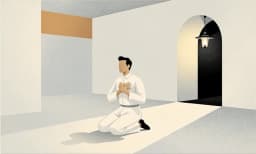
SUFISM
Once the quarrel has hardened past mending, the debt must be paid down to the smallest coin. A man learns too late that the price of pride is exact and complete, and nothing owed is quietly waived. What a soft word on the road could have settled is now a full account with no discount for good intentions.
The disease is the delay itself, the heart that keeps postponing its apology as if the cost will shrink. It only grows. The cure is to pay early, while paying is cheap, offering now the humility you will otherwise be forced to give in full. Settle the small debt today and you are spared the whole of it.

SUFISM
The prison and the full debt sound like pure punishment, a door that stays shut. Yet the same justice that locks the gate is the justice that names an exact price and no more, so that when the last coin is paid the door must open. Nothing is arbitrary; every measure is counted.
So even the cell holds God, met now as the exact reckoning that will not cheat him in either direction. The debt is real, but so is its end. What looks like a place with no way out is the very place where being made to pay in full is what finally sets him free.
Ego v. Being lens
What am I still carrying that I could put down today?
He wronged me, he robbed me: in those who nurse such thoughts, hatred never comes to rest. In those who lay them down, it ends.
The harm is not in what was done to you but in the judgment you keep rehearsing about it. Take away the opinion and the injury has nowhere left to live.
No prayer settles what you owe another person. You have to go to them directly and make it right before anything is clear.
Free · No account needed
Lensightful opens every verse of the Bible through the traditions you choose. Save readings, ask a follow-up question, and get one verse a day.
Get Lensightful on the App Store Ego v. Being
 Psychoanalysis
 Clinical Psychology
 Buddhism
 Cybernetics
 Sufism (Ghazali)
 Sufism (Ibn Arabi)