

Matthew 5:36 · World English Bible
Matthew 5:36 Meaning Neither Shall You Swear by Your Head
Neither shall you swear by your head, for you can’t make one hair white or black.
Matthew 5:36 · World English Bible
Neither shall you swear by your head, for you can’t make one hair white or black.
At last the vow comes home to your own head, and here the illusion is laid bare. You swear as though you were the author of your life, yet you cannot even turn a single hair from dark to light.
From the Ego v. Being reading below.
The same verse, read by 7 traditions.

EGO & BEING
At last the vow comes home to your own head, and here the illusion is laid bare. You swear as though you were the author of your life, yet you cannot even turn a single hair from dark to light. The one making the grand promise does not command the smallest thing.
This is the mind mistaking itself for the doer. It postures as master of a future it has no power to touch. See this clearly and something in you relaxes. You stop pledging what was never yours to pledge and settle into the life that is actually living through you. Presence needs no oath, because it does not pretend to a control it does not have.

PSYCHOANALYSIS
Swearing by your own head is a way of pretending you run the whole of yourself. But a single hair that turns white overnight, without asking your permission, shows where your control actually stops and something larger takes over.
The hidden, deeper side of a person changes on its own, now fair, now dark, now white, and you cannot order it around. Across many traditions, cutting or losing hair has stood for a change no one can force, a renewal you can only receive. Real growth toward a whole, true self begins only when you stop claiming to be master of everything and let that wholeness, which no promise can bind, do its work.

CLINICAL PSYCHOLOGY
A man will stake his own head on a promise, as if his very self were his to command completely, and this is a revealing kind of vanity. You cannot govern the color of a single hair. So much of what you are was handed to you, grown without your permission, aging on its own schedule regardless of your will.
To swear by yourself is to overestimate how much of yourself you actually own. The honest move is smaller and harder: admit how little you control, and then simply do the thing you said you would do. Being trustworthy comes from that quiet effort, not from grand pledges staked on powers you never had.

BUDDHISM
Māna: Conceit To swear by your own head is to hold it up as a fixed, reliable thing, as if the self were a rock on which an oath could rest. Māna is the conceit that treats the sense of "I" as solid and commanding, something others can count on to deliver. The verse cuts that assumption at the root: you cannot govern your own hair, so the self you are invoking as guarantor is already hollow. The oath collapses before it is spoken.
Anattā: Non-self The hair does not ask your permission to turn white. Anattā is the recognition that the body runs on causes and conditions, not on the will of a ruling self at the center. Swearing by your head assumes a "you" who owns and commands it; the verse points directly to the gap between that assumption and what the body does. There is no commander inside who can make good on that oath.
Anicca: Impermanence Hair whitens, skin changes, the body ages along its own schedule regardless of our intentions. Anicca is the fact that everything conditioned follows its own causes, not our preferences. The verse uses the hair's color as evidence: the very thing you are invoking as your guarantee is already slipping out of your hands. An oath sworn on something impermanent is sworn on sand.
Sacca: Truthfulness Sacca, one of the ten perfections of character, is the alignment of speech with what is. When words already match reality, they need no backing, no heaven, no earth, no head. The presence of an oath signals that the words alone are not trusted, which means something in the speech has already drifted from truth. The verse calls for speech so clean that elaboration becomes unnecessary.
Sammā-vācā: Right Speech Right speech, the path factor governing how we use words, calls for honesty, timeliness, and purpose. Swearing by your head layers ceremony and self-assertion onto what could simply be said. The elaboration is itself a kind of noise. Right speech trusts that words spoken honestly carry their own weight, just as still water holds a reflection without effort.

CYBERNETICS
To stake your very head on a promise, when you cannot so much as turn a single hair, is to gamble with authority you were never given. It is the bluff of a person who feels he must guarantee tomorrow in order to be believed today.
Worry over what you cannot control only feeds an anxious mental picture and drains the confidence you need now. Aim your energy at what is actually yours: this moment, this word, this action. A person who tends the present he can shape stops needing to swear on the future he cannot.
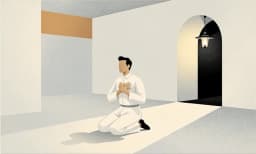
SUFISM
A man swears by his own head as if he owned it, staking a self he does not actually control. He cannot turn a single hair white or black, yet he pledges the whole thing to make his words sound final.
Underneath this is a swollen sense of self, a heart that imagines it commands more than it does. The cure is to see honestly how little is truly in your hands and to speak from that smallness. When a man admits he does not own even his own hair, the puffed-up self deflates, and he no longer needs to pledge what was never his to give.

SUFISM
A man swears on his own head as if his life were his to pledge. But he cannot turn a single hair from dark to white. Even his body is not his handiwork; it is being made, hair by hair, by Another, and he is watching it happen more than doing it.
So the last thing a person might stake, his very self, turns out to be borrowed too. Here God shows Himself in the one place we were surest we owned: this head, this life, held in being by Him from the inside. Seeing that, a person stops staking what was never his and simply lets his plain word stand, resting on the One who actually holds him together.
Ego v. Being lens
What am I exhausting myself trying to control?
The one who grasps at the world loses it. Life moves on its own, and the hand that tries to steer every turn only tires.
You can offer your effort. The fruit of it was never in your hands, and claiming it as yours is the root of the strain.
Some things are up to us, most are not. Our body, our reputation and our circumstances are borrowed, and peace begins the moment we stop pledging what we do not own.
Free · No account needed
Lensightful opens every verse of the Bible through the traditions you choose. Save readings, ask a follow-up question, and get one verse a day.
Get Lensightful on the App Store Ego v. Being
 Psychoanalysis
 Clinical Psychology
 Buddhism
 Cybernetics
 Sufism (Ghazali)
 Sufism (Ibn Arabi)