

Matthew 6:13 · World English Bible
Matthew 6:13 Meaning Bring Us Not Into Temptation
Bring us not into temptation, but deliver us from the evil one. For yours is the Kingdom, the power, and the glory forever. Amen.’
Matthew 6:13 · World English Bible
Bring us not into temptation, but deliver us from the evil one. For yours is the Kingdom, the power, and the glory forever. Amen.’
Temptation is the pull to choose the ego again, to believe for a moment that attack is justified, that guilt is real, that a self apart from love could be safer trusting fear. To ask not to be led there is to ask for the willingness to keep choosing love, and what is called evil is nothing but the mind that has forgotten it may choose once more.
From the Christian Psychology reading below.
The same verse, read by 8 traditions.
 Christian Psychology
 Ego v. Being
 Psychoanalysis
 Clinical Psychology
 Buddhism
 Cybernetics
 Sufism (Ghazali)
 Sufism (Ibn Arabi)

CHRISTIAN PSYCHOLOGY
Temptation is the pull to choose the ego again, to believe for a moment that attack is justified, that guilt is real, that a self apart from love could be safer trusting fear. To ask not to be led there is to ask for the willingness to keep choosing love, and what is called evil is nothing but the mind that has forgotten it may choose once more.
Deliverance is remembering where reality lies. The kingdom, the power, and the glory belong to love alone, never to the frightened self that seemed to seize them, and a mind that returns them to their source is set free by the very act of recognizing they were always there.
Kingdom: the wholeness that belongs to love, the reality the ego borrows and calls its own, the realm returned to its true source the moment the mind stops seizing it

EGO & BEING
Temptation is the pull of the mind to lose yourself in the next thought, the next craving, the next grievance that promises to complete you. To be led away from it is to stay awake, to remain present rather than swept off by the current of compulsion.
Then comes the great releasing. The kingdom and the power and the glory are not yours to seize; they belong to the source of life itself. When you finally stop trying to own them through the ego, you rest in them, and that surrender is what actually delivers you from the darkness of a self that thought it stood alone.

PSYCHOANALYSIS
Asking to be delivered names the dark force as something you cannot absorb and heal on your own, while the closing praise hands all power back to the image of God as the only ground of wholeness.
In the wilderness, a deeper power beyond the personal self, loaded with the world's hunger to dominate, pressed its temptation on the one who carried the whole and true self. Even he could not skip the careful request, the admission that facing such piled-up darkness takes more than personal willpower. That darkness is still loose in the world, not yet defused. Handing the kingdom and the glory back to the Father is a person releasing their swollen self-importance back to its source, the way a clenched hand opens.

CLINICAL PSYCHOLOGY
This is a man who knows he is not as strong as he would like to believe. To ask not to be led into temptation is to admit that under the right pressure you could become the very thing you despise, and that honest fear is the beginning of not becoming it, because the person who thinks himself incapable of evil is the most dangerous of all.
So you ask for help staying on the path and for protection from what would pull you off it. You keep the highest good at the summit and confess your own fragility beneath it. Knowing you could do wrong is precisely what makes it possible to keep choosing right.

BUDDHISM
Taṇhā: Craving
The word behind "temptation" (peirasmos) names a solicitation, a putting to proof, a pull that tests the mind. Taṇhā is this inner thirst: it flares when something desirable comes into range, the way a dry throat reaches for water it cannot stop drinking. It runs as a current beneath the mind, mostly unnoticed, and grows stronger when conditions feed it. "Carry us not inward to this trial" recognizes that where we place ourselves either feeds the thirst or starves it, and asks to be kept away from places where it runs strong.
Kilesa: Mental Defilements
Behind taṇhā stands the whole cluster of kilesas: greed, hatred, and delusion, the three roots from which unwholesome action springs. Together they are the dry wood that makes any spark a fire. The verse's petition partly acknowledges that these roots are still present in the mind, and that this makes exposure to strong testing dangerous. Deliberately stepping into conditions where they are likely to ignite is heedlessness dressed as faith.
Māra: The Obstructor
In the Pali Canon, Māra is the force of obstruction, delusion, and death, appearing again and again to confront the Buddha and his disciples at moments of weakness, finding the gap in watchfulness. "The evil one" (poneros: hurtful in effect and influence) names the same recognition: something actively works against those walking toward liberation, and rescue, more than personal strength, is what the endangered mind needs. The prayer asks to be drawn out of Māra's reach.
Saraṇa: Going for Refuge
The doxology "for yours is the kingdom, the power, and the glory forever" attributes all ultimate power away from the one praying. In Theravāda, the foundational act of Buddhist life is going for refuge (ti-saraṇa): the formal acknowledgment that the Buddha, Dhamma, and Sangha hold what one cannot hold alone. The doxology does the same work structurally: it closes the prayer by setting down the self's claim and locating power in the source rather than the petitioner.
Appamāda: Non-Heedlessness
Prayer for protection, as Jesus frames it here, is an act of daily vigilance: a standing acknowledgment that the mind is exposed to testing and needs help. Appamāda is the quality of not letting the guard drop, of staying alert to what is arising before it takes root. The Buddha's reported last words called for it: all conditioned things pass, strive on with diligence. A prayer that names temptation each day is this same practice, keeping the mind alert before the pull arrives.

CYBERNETICS
Much of what pulls a person off course begins as a mental picture entertained too long, a scene rehearsed in the imagination until the feet follow. Asking not to be led into it is really asking to keep guarding what plays in the inner theater, because you become the images you dwell on.
The prayer then closes by returning the sense of power to its true source rather than to the fearful small self. When a man rests his security there instead of in his own strained willpower, the pull of the wrong picture loses its grip, and he is steadied from a strength larger than his own.
SUFISM
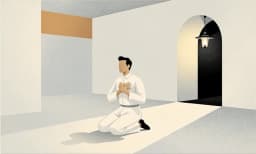
The prayer ends by admitting weakness, asking to be kept from the pull toward ruin, and this honesty is itself a healing. A man who thinks himself strong walks straight into the appetites that overpower him, while the man who confesses he can be led astray stays close to the One who can hold him.
The disease is the pride that believes it needs no guarding. The cure is to lean on God's strength rather than trust your own, naming Him the true power. Pray this way, and self-confidence gives way to protected humility, and the heart is defended from within by admitting it cannot defend itself.
SUFISM
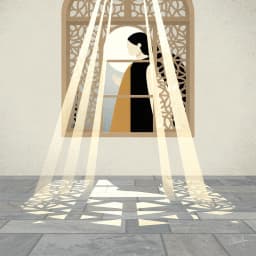
To ask not to be led into the hard testing is to admit that a person on his own is a thin, unsteady thing, easily pulled apart, and that whatever holds him together is on loan from elsewhere. The prayer ends by handing everything back: the rule, the strength, the shining are all His, never truly ours to guard.
What looks like our own footing was always His footing under us. Here the teacher is showing that God is the single power beneath a person's whole standing, and the man who says these last words stops pretending to hold himself up and leans fully on the One who was carrying him the entire time, which is the safest place he could possibly be.
Christian Psychology lens
What am I holding onto right now that I could simply hand back?
The mind is both the friend and the enemy of the self. Trained, it carries you; left to its own grasping, it turns on you, and the whole work is learning which way to point it.
Nothing outside your own judgment belongs to you, and nothing outside it can harm you. The moment you stop claiming what was never yours, there is nothing left for anyone to take.
What looks like an enemy is the untrained mind, and no outside foe can do what it does. Guard the choice, and the harm has nowhere to enter from.

Free · No account needed
Lensightful opens every verse of the Bible through the traditions you choose. Save readings, ask a follow-up question, and get one verse a day.
Get Lensightful on the App Store