
Bible symbol · 5 lenses
What Does Light Mean in the Bible Read through 5 lenses
God said, “Let there be light,” and there was light.
God said, “Let there be light,” and there was light.
Light: understanding, which is never drawn out of darkness but simply is, and the will the Son shares with his Creator, holding all the power of creation
Christian Psychology lens · Genesis 1:3
In him was life, and the life was the light of men.
This is the message which we have heard from him and announce to you, that God is light, and in him is no darkness at all.
You are the light of the world. A city located on a hill can’t be hidden.
Same symbol, 5 ways of seeing it. Tap one to jump to it.

The first thing made is knowing. Light standing clear of darkness is the oldest experience anyone has, awareness lifting itself out of what lies below it in the mind, and here that experience is spoken over the whole world at once. Darkness was there first, which makes it the mother of the light rather than its enemy; the light is what the dark brought forth.
The spirit that brooded over the water just before this made water spiritual for good, and the alchemists could say plainly that water is spirit. An early church father read the one day as a creature coming to know itself: evening is that self-knowledge held alone, dim as twilight, and morning is the same knowledge seen inside God, where it stands in full light.

Life and light are one thing seen twice. What is truly alive in a mind is the same as what lets it see, for both are the presence of love that separation tried to hide. A mind convinced it lives inside a body has confused living with the small flicker of fear, but real life was never in the flesh. It was always the awareness that shines, the quiet knowing that the mind is not alone.
So the light of men is not a lamp lit against the dark. It is the recognition that the darkness was never there, that every mind carries within it the same living clarity and only has to turn toward it. To be alive, in the end, is simply to see truly.
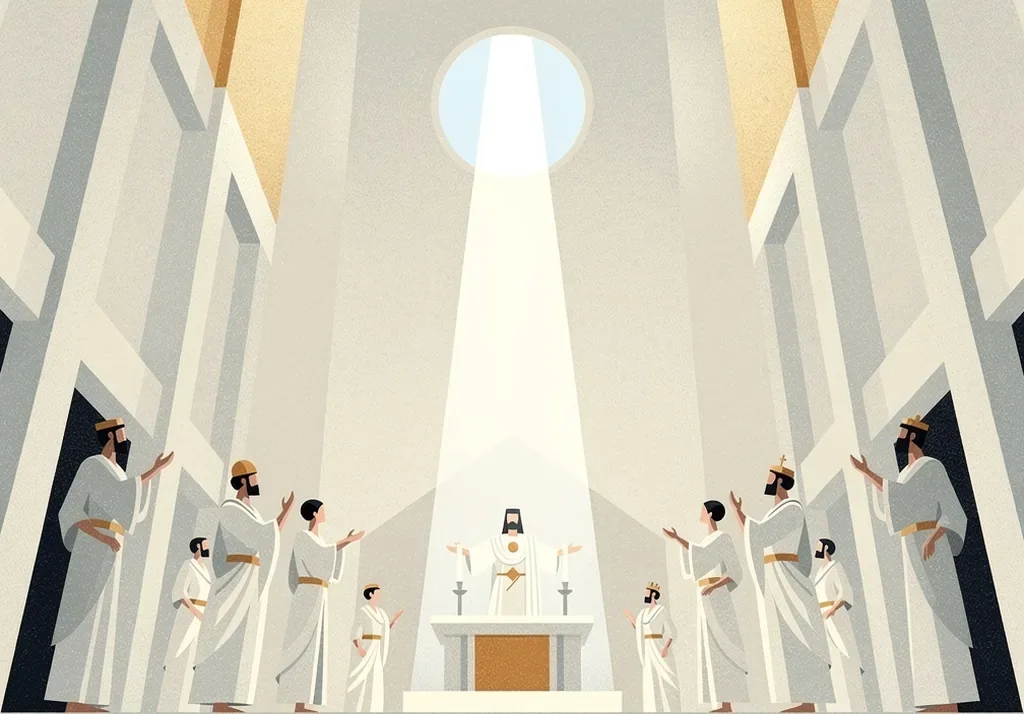
God is light in the most literal sense the writers could reach: the invisible photon, the radiance standing behind all matter and holding no shadow. The single eye Jesus named is the pineal gland deep in the head, the seat where this inner light is worked, and its melatonin is the very substance spoken of here. A person is not only told about light; the body itself faintly emits it, made of the same brightness. To find God is to find the light already burning at the center of one's own head, needing only stillness to be seen.
The mind is already light (pabhassara citta). Not a gift conferred, not a quality earned. "You are the light of the world" names what was always present, now cleared enough to show.
A life of moral restraint (sīla) is the hill. It does not need to announce itself. It stands above the ordinary plane by what it is, not by what it declares.
Good will without limit (mettā) determines the reach: the whole world, no one excluded, no circle drawn around the likeable.
Heedfulness (appamāda) keeps the lamp uncovered. "A city on a hill can't be hidden": what is genuine has no mechanism for concealment.
The hill does not choose to be seen. What is real cannot hide itself.

Everything perishes except His Face: one thing alone does not pass away The Quran says it, and Sufis repeat it more than almost any other line. Money, position, and a good name feel solid while you hold them, and every one of them is on loan. Seeing that loosens the grip, and losing things starts to hurt less, because you stopped asking them to last.
Nūr: Light Al-Ghazali held that God alone shines with light of His own, while everything else borrows what it has. A lamp still burns at noon, and you can hardly tell it is lit. Someone who sees that their best thoughts about God run on borrowed light stops treating those thoughts as the final word.
His veil is light: the brightness itself is what keeps us out A saying of the Prophet describes God's covering as light, and al-Ghazali comes back to it often. People assume the obstacle must be some fault in them, something dark to clean up first. Too much light blinds as surely as too little, so failing to see Him stops feeling like a personal failure.
Inability to grasp Him is itself understanding: the limit belongs to the knowing Abu Bakr said it, and Sufis have quoted him ever since. The mind reaches for a picture of God, comes back with nothing that holds, and the emptiness feels like defeat. Coming up empty is accurate, since a God small enough to picture would be one more object among the rest.
Kibriyāʾ: Grandeur In a saying of the Prophet, God calls grandeur His cloak, worn by Him alone. Wanting to be admired is one of the last hungers to fade, and it hides comfortably inside good work. Handing honor back to its owner takes weight off a person, since a name you never owned needs no guarding.
One line per lens.
In Lensightful, names, numbers and symbols light up in the text. Tap one to see what it means in each tradition you choose.
Get Lensightful on the App Store