
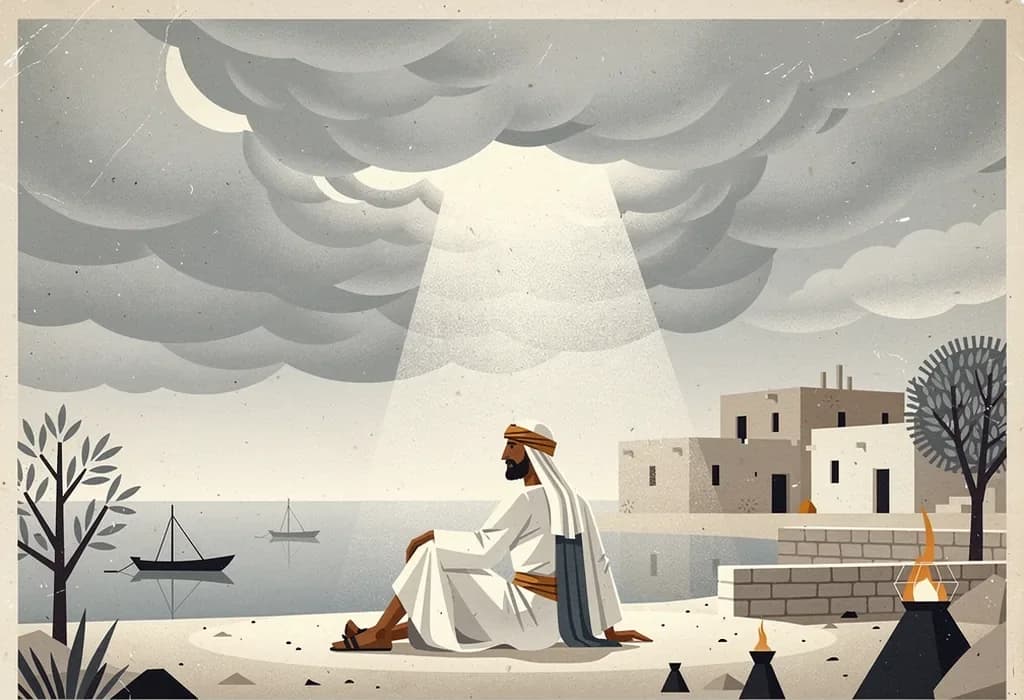
Job 1:21 · World English Bible
Job 1:21 Meaning He Said
He said, “Naked I came out of my mother’s womb, and naked will I return there. Yahweh gave, and Yahweh has taken away. Blessed be Yahweh’s name.”
Job 1:21 · World English Bible
He said, “Naked I came out of my mother’s womb, and naked will I return there. Yahweh gave, and Yahweh has taken away. Blessed be Yahweh’s name.”
A man who has lost everything in a single day speaks the hardest sentence a person can mean. He owned none of it.
From the Clinical Psychology reading below.
The same verse, read by 3 traditions.

CLINICAL PSYCHOLOGY
A man who has lost everything in a single day speaks the hardest sentence a person can mean. He owned none of it. Children, wealth, health, all of it was lent, and the ledger never belonged to him. To grasp that before catastrophe arrives is to be armored against despair when it comes.
He blesses the name even as the gift is withdrawn, because his footing rested in the order that gave and took, never in the possessions themselves. A man loses his children and still stands. Bind your worth to what can be seized and its seizure destroys you. Anchor it deeper, and no thief can reach the ground you stand on.

SUFISM
Faqr: Poverty, holding nothing as your own The term points at a fact about ownership. Health, family, money, all of it came from outside a person and moves on again, whatever the paperwork says. Someone who knows this before a loss arrives feels the loss as a loan going back, not as a theft.
Tawḥīd al-afʿāl: Oneness of action, one hand behind every event Al-Ghazali describes a stage where a person stops counting up the people and accidents that caused the damage. Blame scatters a grieving mind across a dozen faces, each one replayed and argued with at night. Seeing one hand behind both giving and taking gathers all that back, and leaves someone to speak to instead of names to resent.
Patience is at the first blow: the first hour is what counts The Prophet said this about the moment the news lands, not the long months after. In that first hour a person loses their composure and says whatever sits nearest the surface. Words that come out before anyone has time to prepare them show the ground a person stands on.
Riḍā: Contentment with what comes Patience carries a weight; contentment sets it down and stops arguing with it. Someone in this state has dropped the private case against how things went, the endless rerun of what should have happened. The pain stays, but the fight with the fact falls away, and for most people that fight was the heavier part of the load.
If I worship You in hope of paradise, shut me out: devotion that wants nothing back Rabia prayed along these lines, refusing to serve God for a payout. When the gifts stop, a person finds out whether their devotion was attached to the gifts or to the one giving them. The praise offered when nothing is left settles a question about a person that comfortable years never could.
Shukr: Gratitude, giving credit where it came from Al-Ghazali sets gratitude beside patience and treats them as halves of one life with God. Thanks that only show up when things go well are tied to the weather. Thanks that keep coming through a bad stretch hold a person steady, because they keep facing the giver rather than the ledger.

SELF-HELP
The difference between a grieving man and a blessing man is the accounting each one did before the loss ever came.
Expectation files every good thing under property, so its leaving reads as robbery, and robbery sets grievance, and grievance moves a person to prosecute their own life and everyone standing in it. Appreciation files the identical thing as given, so the taking ends a gift instead of exposing a theft, and the state holds.
A man stripped bare in a single afternoon could still bless Yahweh's name because he had never once stood in that relationship as a creditor. Hold the creditor's posture and every loss costs twice, once in what left and once in the years spent collecting on a debt no one ever agreed to.
Clinical Psychology lens
If the things I count on were taken this week, what would be left standing in me?
Never say you lost something, say you gave it back. It was lent to you from the start and the lender chooses the hour.
Everything you hold is already in motion toward leaving. Love it fully and hold it loosely, because the grip is what breaks you, not the loss.
What is truly you was never one of the things that can be taken. Grief comes from mistaking the borrowed for the self.

Free · No account needed
Lensightful opens every verse of the Bible through the traditions you choose. Save readings, ask a follow-up question, and get one verse a day.
Get Lensightful on the App Store Clinical Psychology
 Sufism
 Self-Help