
Job 3:26 · World English Bible
Job 3:26 Meaning I Am Not at Ease
I am not at ease, neither am I quiet, neither have I rest; but trouble comes.
Job 3:26 · World English Bible
I am not at ease, neither am I quiet, neither have I rest; but trouble comes.
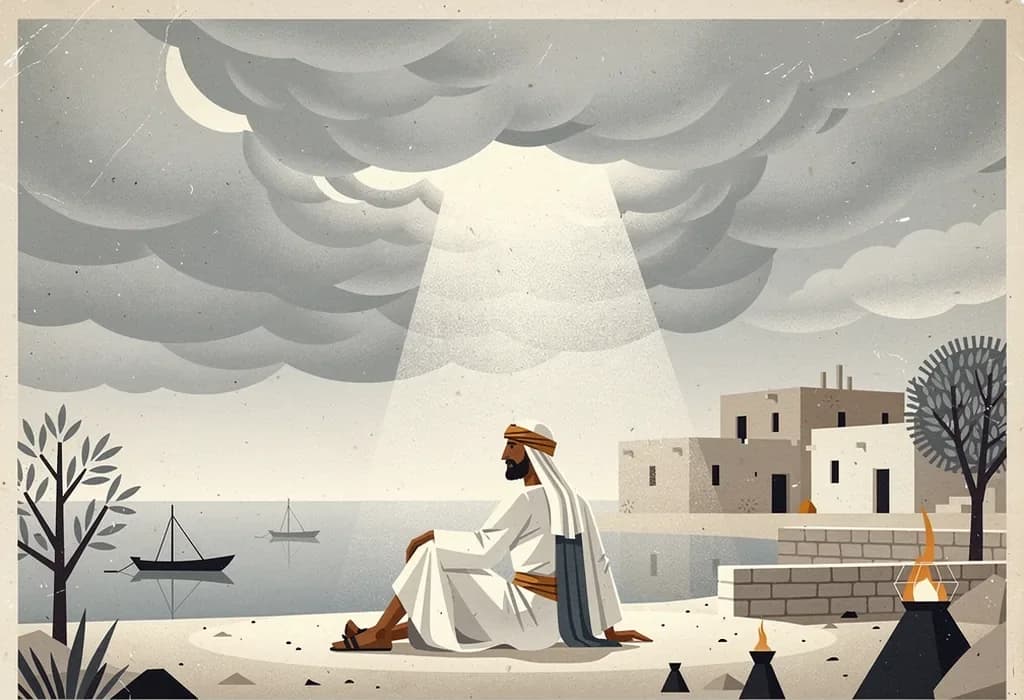
A man lists everything he did not have. No safety, no rest, no quiet.
From the Ego v. Being reading below.
The same verse, read by 3 traditions.

EGO & BEING
A man lists everything he did not have. No safety, no rest, no quiet. He had spent his days guarding against calamity, and calamity arrived anyway, walking straight past all his vigilance.
Here the mind's oldest bargain stands exposed. It believes that if it worries hard enough, stays braced enough, never lets its guard down, it can keep pain outside the door. Job's cry is the moment that bargain breaks. The suffering came regardless. What his sleeplessness bought him was not safety but only more suffering, laid on top of the trouble it was meant to prevent.

BUDDHISM
Dukkha: Suffering Dukkha is the ache built into a life that keeps slipping out of our hands. Trouble came even after his safety and rest had already failed, landing like a bill in the mail that shows up whether or not there is money to pay it, indifferent to how tired the house already is. No effort bought him an exemption, because uninvited trouble is simply the ordinary condition of a life not yet worked free.
Anicca: Impermanence Anicca is the plain fact that everything we hold will change. He was not in safety because safety was only ever on loan, a footing on wet sand that the next wave slides out from under you no matter how still you stand. Ground that solid was never there to keep, so the hunt for one spot that stays put keeps coming back empty-handed, and seeing the loan for what it is takes some of the shock out of the wave.
Uddhacca-kukkucca: Restlessness and worry Uddhacca-kukkucca is the churn of a mind that will not settle, restlessness stirred together with worry. Even with no rest and no quiet anywhere in reach, his trouble was already boiling inside long before any of it arrived from outside, the way a covered pot keeps rattling its lid over a flame you forgot to turn down. Lying down changed nothing at all, because the heat was under the water, not in the bed he was lying on.
Khema: Safety and refuge Khema is the one safety that nothing outside can break into, the shelter the whole path is walking toward. The safety he reached for was a bolted door on a house built out of weather, and khema is the refuge that bad news never learns the address of, no matter how long it knocks around the neighborhood. It grows as the grip loosens, the same white-knuckle grip that made him feel he needed walls in the first place.
Santi: Peace Santi is stillness, the peace that stays lit when everything around it goes dark. He had no quiet because he was chasing quiet as a break between troubles, a thin gap that the next trouble always slammed shut before he could rest in it. The peace the path offers keeps burning like a lamp through the whole storm, lit by the path itself, so no passing trouble gets a vote on whether it stays.

AWARENESS
Honest despair is worth more than a comfortable belief. A man who has lost everything and admits that quiet never came, not even in the good years, has stopped pretending, and the pretense was holding the whole structure upright.
Restlessness does not arrive with misfortune. It is the mind itself, forever leaning into the next moment, and calamity only strips away the distractions that were covering it. Thought can never deliver rest, because thought is movement. Underneath it there is a stillness that none of the trouble has touched, and it becomes available the moment attention turns from the trouble to whatever in him is aware of it.
Ego v. Being lens
What are you guarding against that your worry has no power to prevent?
There are more things likely to frighten us than to crush us, and we suffer more often in imagination than in reality. The person who worries endlessly lives through their troubles twice.
The careful man binds and locks his boxes against thieves, and only makes it easier for the great thief to carry everything off at once. Precaution is not protection.
The first arrow is the pain that actually strikes you. The second is the one you shoot into yourself about it, and only that one is optional.

Free · No account needed
Lensightful opens every verse of the Bible through the traditions you choose. Save readings, ask a follow-up question, and get one verse a day.
Get Lensightful on the App Store Ego v. Being
 Buddhism
 Indian Guru