

Matthew 6:18 · World English Bible
Matthew 6:18 Meaning So That You Are Not Seen
so that you are not seen by men to be fasting, but by your Father who is in secret, and your Father, who sees in secret, will reward you.
Matthew 6:18 · World English Bible
so that you are not seen by men to be fasting, but by your Father who is in secret, and your Father, who sees in secret, will reward you.
When a person fasts to be admired, the ego takes over the act. It turns even self-denial into a display, hungry for the gaze of others, and the emptiness it wanted to fill only grows.
From the Ego v. Being reading below.
The same verse, read by 9 traditions.
 Ego v. Being
 Psychoanalysis
 Clinical Psychology
 Buddhism
 Cybernetics
 Sufism (Ghazali)
 Sufism (Ibn Arabi)
 Sufism
 Indian Guru

EGO & BEING
When a person fasts to be admired, the ego takes over the act. It turns even self-denial into a display, hungry for the gaze of others, and the emptiness it wanted to fill only grows. Without an audience, that hunger starves.
To fast unto the Father in secret is to do the thing for its own quiet sake, unseen. This secret is the still awareness underneath every thought, present when no one applauds. It sees what the crowd cannot, and it asks for no witness. What ripens in that hidden ground will one day show plainly in how a person lives, calmer and more whole than any performance could make them.

PSYCHOANALYSIS
Doing religious discipline in front of watchers is the ego swapping its hunger for approval in place of real change, trading the meeting with your true self for the crowd's applause.
Fasting in private, hidden from the audience that would praise it, pulls your attention back from the crowd's gaze. The crowd here stands for the pull of the herd, the faceless mass that works against becoming your own person. What the Father who sees in secret meets is not a performance but something real: the deep center of you, meeting a person with the mask taken off. Like someone alone in a quiet room with an honest pulse of grief, the secret fast holds real feeling inside instead of putting it on display.

CLINICAL PSYCHOLOGY
The most important things you do are the things no one witnesses. The discipline you keep alone, the temptation you refuse when it would cost you nothing to give in, the small acts of order maintained in private, these are the true measure of a person, and they are invisible by design. Something real is being built in that hidden place.
And what you construct in secret does not stay secret forever. Character formed away from any audience eventually shows itself in how you carry yourself, in the steadiness others come to rely on, in a life that holds together under pressure. The private work becomes a public reality. Who you are when no one is looking is what you slowly, inevitably become in the open.

BUDDHISM
Māna: Conceit
Māna is the mind's compulsion to measure itself by what others see. Beyond simple arrogance, it covers any posture of the self that needs an audience to feel solid. The person who arranges their face to signal fasting is feeding this hunger directly. Buddhist teaching names māna as one of the last fetters to fall away on the path, because it is so quiet and so constant: a practice that would wither if no one were watching has māna at its root.
Taṇhā (bhavataṇhā): Craving for becoming
Taṇhā is craving, and its subtlest form, bhavataṇhā, is the craving to become a certain kind of person in the world's estimation. The public faster is also building an identity, the recognized devotee, the known ascetic, and that project runs on craving. This is the second Noble Truth, the origin of suffering, because an identity assembled from others' recognition has no stable ground. Remove the audience and the self built there falls away with it.
Cetanā: Intention
The Buddha said cetanā is kamma: intention is the seed from which every action grows its fruit. Two people can fast identically in body while planting entirely different seeds, because one wants to be seen and the other wants to turn inward. The verse draws this line exactly: the outward act is the same, but the intention splits what follows into two entirely different directions. Cetanā is the hinge the whole passage turns on.
Vipāka: The fruit of action
Vipāka is the ripened result of intentional action. The public faster has already received theirs, human approval, a thin fruit quickly spent. The private faster plants a different cetanā, one whose fruit is not consumed at the moment of display. Buddhist teaching holds that wholesome intention, untangled from recognition, carries forward by its own weight. The reward the verse promises is the natural ripening of what was planted in silence.
Hiri: Moral conscience
Hiri is the inner sense of decency that functions without a witness. A person with hiri does not need to be watched to behave well; the knowing is already present inside. Buddhist teaching calls hiri and its companion ottappa the guardians of the world, because together they hold conduct upright when no one is looking. The verse's call to fast where only the unseen Father sees points directly to this quality: let practice rise from the inside.

CYBERNETICS
What you rehearse in private, where no one is watching, is what shapes the self-image, and the self-image is what shows up in your outward life. The theater of the mind runs whether or not anyone applauds, and its quiet performances are the ones that take.
A man who does his real work unseen is planting a picture that no observer put there and no observer can take away. That inner image ripens on its own schedule and eventually surfaces in how he carries himself. The reward comes openly because it was grown honestly, from the inside out.
SUFISM
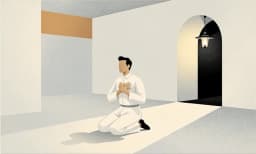
There is a kind of worship that only breathes in the dark, where no one is watching and there is nothing to gain but God himself. A man who can do good with the door shut has shown that his goodness is real, because he did it when no praise could reach him.
The disease is the heart that needs an audience before it will act, that grows warm only when eyes are on it. The cure is to trust that the unseen God is a truer witness than any crowd, and that what he sees in secret he keeps and returns. Do the hidden good for him alone, and the reward is safe, because it was never handed to people who forget you by morning.
SUFISM
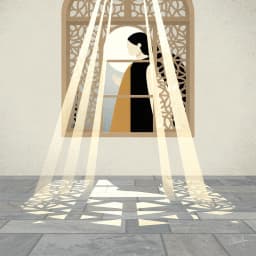
There is a seeing that reaches where no human glance can go. The secret a person keeps is not empty; it is the room where the Hidden One is looking, and being looked at there is worth more than being applauded in the street. What is done for that gaze alone is stored where nothing can spend it.
So the faster who hides his hunger is not throwing it away. He is placing it in the one pair of eyes that misses nothing. God shows Himself here as the witness inside the secret, and the reward is simply that closeness: the man discovers he was never alone in his hiding, and the seeing itself is the gift returned.

SUFISM
Riyāʾ: Showing off in worship Riyāʾ names the itch to be seen doing good. It slips in quietly: someone begins an act for God, then starts picturing how it looks to the people nearby. Al-Ghazali warned that this hollows a deed out from the inside, leaving the effort standing while the point of it drains away.
Ikhlāṣ: Sincerity Ikhlāṣ means doing one thing for one audience. When several people are watching, the heart splits, and some of the effort bends toward whoever can applaud. Dropping every onlooker but God closes that split, and the act stops being a performance; the person no longer minds whether anyone finds out.
Worship as though you see Him, and if you do not see Him, He sees you: the audience already present The Prophet gave this answer when asked what excellence in religion means. Someone doing good in private can feel like the effort is falling into an empty room. The saying shifts the eyes that count from the crowd to God, who was watching before anyone else arrived, so nothing done quietly goes nowhere.
Fasting belongs to Me, and I reward it: the deed no one else can check God speaks these words in a saying the Prophet passed on. Most good deeds leave something visible that others can admire; this one leaves nothing for anyone to confirm. The tradition reads that as the whole point: the act is God's business, and what comes back for it comes from Him.
Bury yourself in the ground of obscurity: what grows unburied bears no fruit Ibn Ata Allah put it plainly in his book of sayings. A person who needs to be seen keeps pulling their own work up to show it, so nothing takes root. The stretch of time when nobody is watching is when someone quietly becomes what they were trying to be.

AWARENESS
Whatever is done for eyes becomes performance, and the ego feeds on exactly those practices meant to dissolve it. Remove the audience and much of what passes for spiritual life stops, because it was never more than a way of being seen.
What stays hidden from every onlooker, including the inner one keeping accounts, is done for no gain, and only such an act reaches the man doing it. The Father in secret is the awareness a person already is, silent behind the thinking; being seen there costs nothing and adds nothing, and that is why it can be trusted.
Ego v. Being lens
What would I still do today if no one ever found out I did it?
The sage acts without laying claim to the action, and because nothing is held up for display, the good done does not wear away.
Do the work that is yours to do, and let go of any grip on how it looks or what it brings back to you. The act stays clean when the reward is not the point.
A good deed needs no audience to be good. If you want a witness, let it be your own clear mind, which already knows whether you acted well.

Free · No account needed
Lensightful opens every verse of the Bible through the traditions you choose. Save readings, ask a follow-up question, and get one verse a day.
Get Lensightful on the App Store